A House in the Rhythm of Cork
In the cork forests of Alentejo, the nine-year harvest cycle teaches a lesson in patience and property ownership.
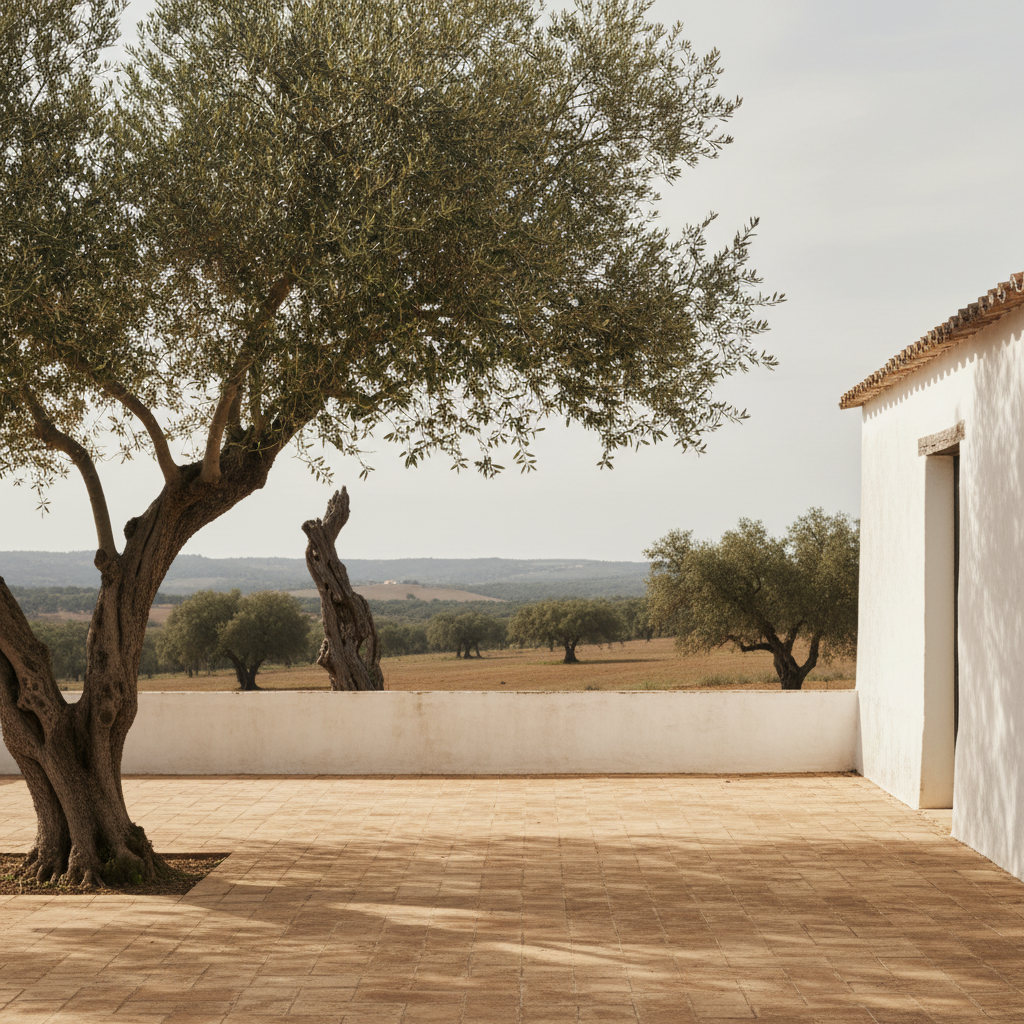
One travels to the Alentejo for the quiet. The region is a reprieve from the coast, a rolling expanse of olive groves and cork forests known as the montado, punctuated by whitewashed villages that appear heat-stunned into silence. It is a landscape that asks for little and seems to promise even less, beyond sun and stillness.
To acquire a house here is to inherit a piece of this quiet. The transaction, however, is not the beginning of the story. Instead, it is an entry into a narrative that has been unfolding for centuries, dictated by a rhythm slower than seasons, and longer than a mortgage.
The defining cadence of the montado is the nine-year cycle of the cork harvest. A cork oak, or sobreiro, is first stripped of its bark no earlier than its twenty-fifth year. The tree is marked with a number—the last digit of the year of its harvest. From then on, it can only be stripped again every nine years, a period of patient regeneration.
The process is careful and skilled. A worker with a small axe makes precise cuts, peeling away the thick cork in wide planks without harming the delicate layer beneath. The exposed trunk, a deep and wounded ochre, is a temporary blemish on the landscape, a sign of a promise nine years hence. The tree will live for two centuries, offering itself up maybe fifteen times in its life.
The Patient Owner
To live among these trees is to internalize their timeline. The modern homeowner’s impulse to impose, renovate, and complete a project within a fiscal year finds little purchase here. The montado teaches a different kind of ownership, one that is more custodial than creative, more about waiting than willing.
A new owner might look at a stand of cork oaks on their property and inquire about the harvest. The answer is often a shrug, a point to the faded number on the trunk, and a simple calculation. The trees are not ready. They will be ready when they are ready. Patience is not a virtue here; it is a simple fact of life, like the summer heat.
To own a house here is to be a guest of a much longer story.
This long cycle informs a quieter way of keeping a home. One learns to observe the slow fade of the limewash on the walls, the gradual settling of the roof tiles. The house is not a project to be finished, but a living thing to be tended. Its needs are met in their own time, in harmony with the larger, slower rhythms of the land.
The frantic energy of renovation is replaced by a practice of slow improvement, of observation, and of acceptance. The house, like the cork oak, is a participant in a long, unhurried narrative. It holds the sun in its walls and offers shade in return. It asks for care, but not for haste. Its value is not measured in its completion, but in its persistence.
In Alentejo, the land holds the deeds. The nine-year wait for the cork to return is a quiet education in the nature of true ownership. It is a reminder that we are temporary stewards of things that will outlast us, and that the most profound value accumulates in the spaces between moments of activity.
The longer reading, with plates and a directory of Alentejo, Portugal, lives in Edition I of the magazine.
The longer reading lives in the magazine.
This essay is one observation. Edition I carries the plates, the studies and the directory of Alentejo, Portugal — thirty pages, on uncoated stock, posted across Europe.
Continue reading
All essays → Editorial · 8 min
What a house is worth, and what it costs
On the difference between price and value, and why we have stopped using the first to describe the second.
 Markets · 11 min
The quiet market
Why the most interesting European homes are no longer listed, and what that means for the people looking for them.