A House Is Not A Project
The modern impulse is to renovate a house in five months; a truer way may require five winters.
The purchase of a house is often followed by a period of intense activity. Plans are drawn, walls are moved, and surfaces are replaced in a flurry of work intended to impress a new owner’s vision onto an old form. The goal is transformation, executed with speed and precision. The house is a project, and the metric of success is how quickly it can be completed, ready for a new life to begin within its freshly finished walls.
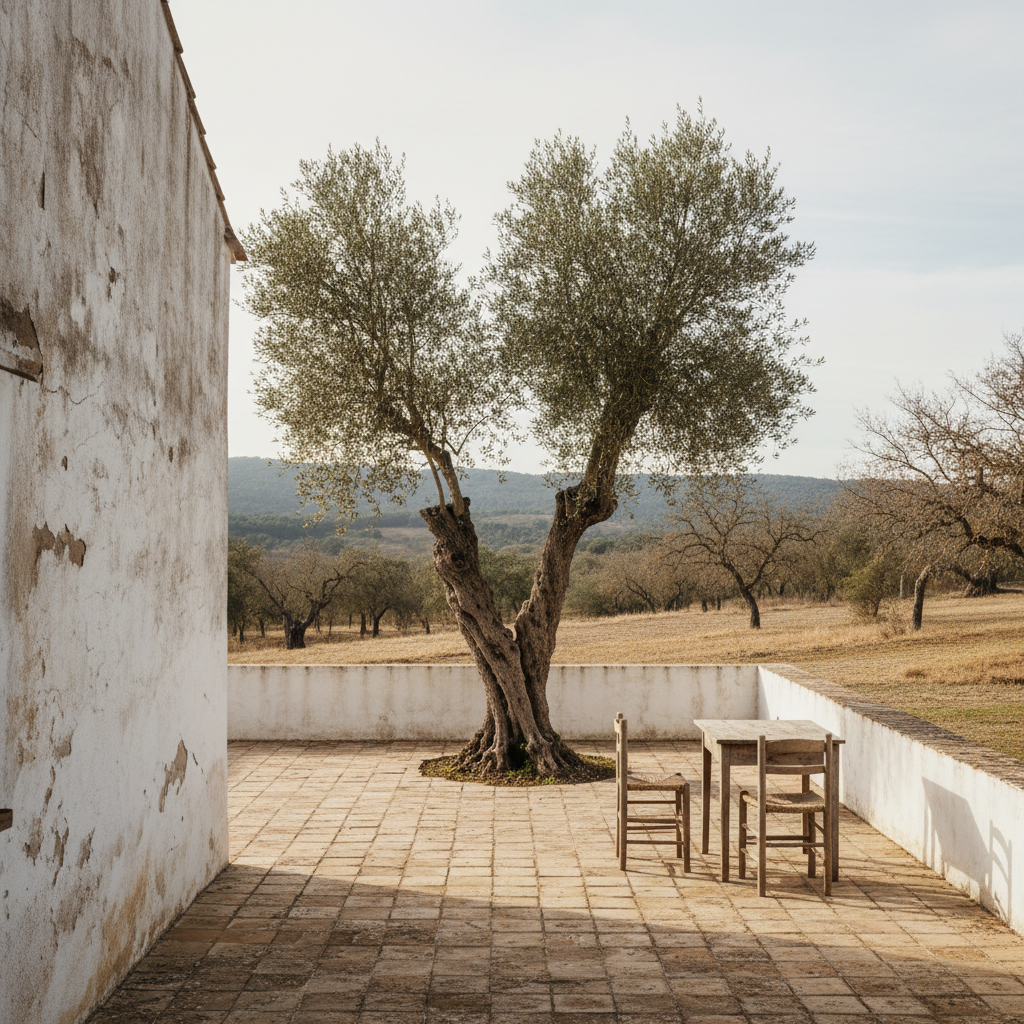
There is, however, another way. It begins with the acceptance of a place as it is. Consider a simple farmhouse in Alentejo, a *monte* set amongst cork and olive trees. It is not a ruin, but a structure that has sheltered lives before. Its walls are thick, its rooms are arranged for a different era’s logic, and its windows are sized for shade rather than for views. The instinct is to correct these perceived imperfections immediately.
What if one were to trade five months for five winters? To approach the house not as a canvas to be painted over, but as a text to be read. This method asks for patience. It demands that the new owner becomes a resident first and a renovator second. The initial work is not of demolition, but of observation.
The first winter is spent in quiet cohabitation. You learn where the drafts originate, how the low sun warms the terracotta floors, which rooms hold the silence best. You notice the way rain streaks the limewashed walls and how the wind sounds moving through the old window frames. The house begins to reveal its patterns and its history. No hammer is lifted. The only tool is attention.
To renovate, in this sense, is not to impose a new identity but to translate an old one.
The second winter might see the first intentional changes. The work is restorative, not revolutionary. The roof tiles are replaced, perhaps, but with local terracotta sourced from a family kiln. The crumbling plaster is repaired with a new coat of lime, a breathable skin that has been used in the region for centuries. The project is no longer about fulfilling a preconceived design, but about entering a dialogue with the building and its vernacular.
The Rhythm of Repair
This slow restoration finds its rhythm with the seasons and the land itself. The Alentejo is a region defined by patience. The cork oaks give up their bark only once a decade. The olives swell through the long, hot summer for a winter harvest. To rush a renovation here feels like a profound misunderstanding of the place. By working with local tradespeople, you inherit their knowledge—a wisdom about materials and climate that has been passed down through generations.
The result, after years, is not a house that feels new, but one that feels settled. It has not been stripped of its character; it has been allowed to deepen it. The slight unevenness in the floor, the gentle wear on a stone sill—these are not defects covered over but textures of a life lived, now part of a continuing story. The home does not stand in contrast to its surroundings but feels like an extension of them.
The house, kept simply, becomes a curator of quiet moments. It is a testament to the idea that the most meaningful spaces are not created in a single, decisive act, but are cultivated over time, through listening, learning, and a partnership with the structure itself. It is a process that changes the house, but also the person who undertakes it.
The longer reading on this subject, with plates and a directory for Alentejo, Portugal, lives in Edition I of the magazine.
The longer reading lives in the magazine.
This essay is one observation. Edition I carries the plates, the studies and the directory of Alentejo, Portugal — thirty pages, on uncoated stock, posted across Europe.
Continue reading
All essays → Editorial · 8 min
What a house is worth, and what it costs
On the difference between price and value, and why we have stopped using the first to describe the second.
 Markets · 11 min
The quiet market
Why the most interesting European homes are no longer listed, and what that means for the people looking for them.