A New Wall Is a Forty-Year Mistake
A new stone wall in the Tuscan countryside can feel like a violation, an object too bright for the ancient landscape.
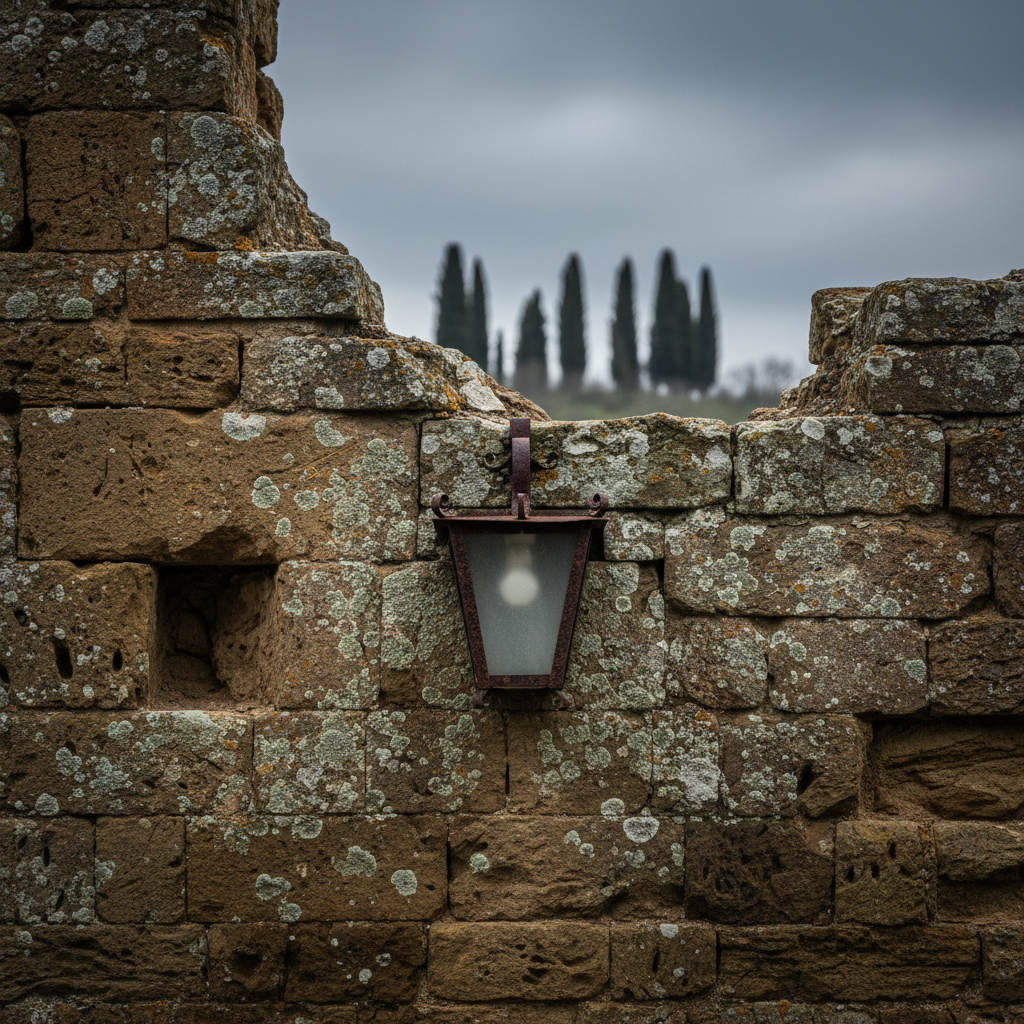
To build in stone is an exercise in patience. To build in Tuscany is to submit to a conversation that is already centuries old. The landscape is a manuscript written in cypress, olive, and limestone, and every new structure is a fresh annotation. More often than not, the first draft is poor.
Consider a new stone wall erected in the Val d'Orcia. It is made of the same earth as its ancient neighbors. The quarry may be just kilometers away. The masons may use techniques passed down through generations. And yet, the result is irreconcilably foreign. It feels loud.
The freshly cut faces of the stone are too bright. The mortar is a stark, clean white, tracing a geometric pattern that feels entirely out of place. The wall does not sit in the landscape; it sits upon it, an object of startling newness in a place defined by its relationship with time.
It stands as a kind of violation. Its crisp edges and uniform color are declarations of the present moment. In a region where every other surface is softened by age, blurred by lichen, and stained by rain, this sharp newness is a visual interruption. It lacks a story.
Time is the essential collaborator in Tuscan construction.
The initial error is not in the design or the material, but in the expectation. A new wall is not meant to look right on its first day, or even in its first decade. It is, for a considerable time, a forty-year mistake. An awkward, adolescent structure that has not yet learned how to belong.
The Slow Correction
For the first few years, the wall is a study in stubbornness. It resists the sun and sheds the rain. But slowly, inevitably, its education begins. Winter frosts will pry at the mortar. The relentless summer sun will bleach the stone, then fade its initial brightness into something more gentle.
Lichen, the first patient colonist, will find a foothold. It will begin its slow, painterly work, stippling the surface with patches of grey-green and muted yellow. Rain will carry dust and soil into the crevices, darkening the stark mortar and softening the rigid geometry. The sharp corners will surrender to slow erosion.
The wall begins to host life. Small ferns may take root in the cracks. Insects will find homes in the gaps. The shadows that fall across its face will no longer seem so harsh. The structure starts to participate in the life of the valley, rather than merely occupying it.
What was initially an object of human will becomes a feature of the natural world. After a century, it has settled in. After four hundred years, it is indistinguishable from the walls that came before it. It has become part of the place. The forty-year mistake has been corrected by four centuries of slow, quiet collaboration.
The longer reading on the patience of stone, with plates and a directory of Tuscany, Italy, lives in Edition III of the magazine.
The longer reading lives in the magazine.
This essay is one observation. Edition III carries the plates, the studies and the directory of Tuscany, Italy — thirty pages, on uncoated stock, posted across Europe.
Continue reading
All essays → Editorial · 8 min
What a house is worth, and what it costs
On the difference between price and value, and why we have stopped using the first to describe the second.
 Markets · 11 min
The quiet market
Why the most interesting European homes are no longer listed, and what that means for the people looking for them.