A Third Room, Between House and Land
In the sparse landscapes of Alentejo, the terrace is not an addition but an essential, intermediate space.
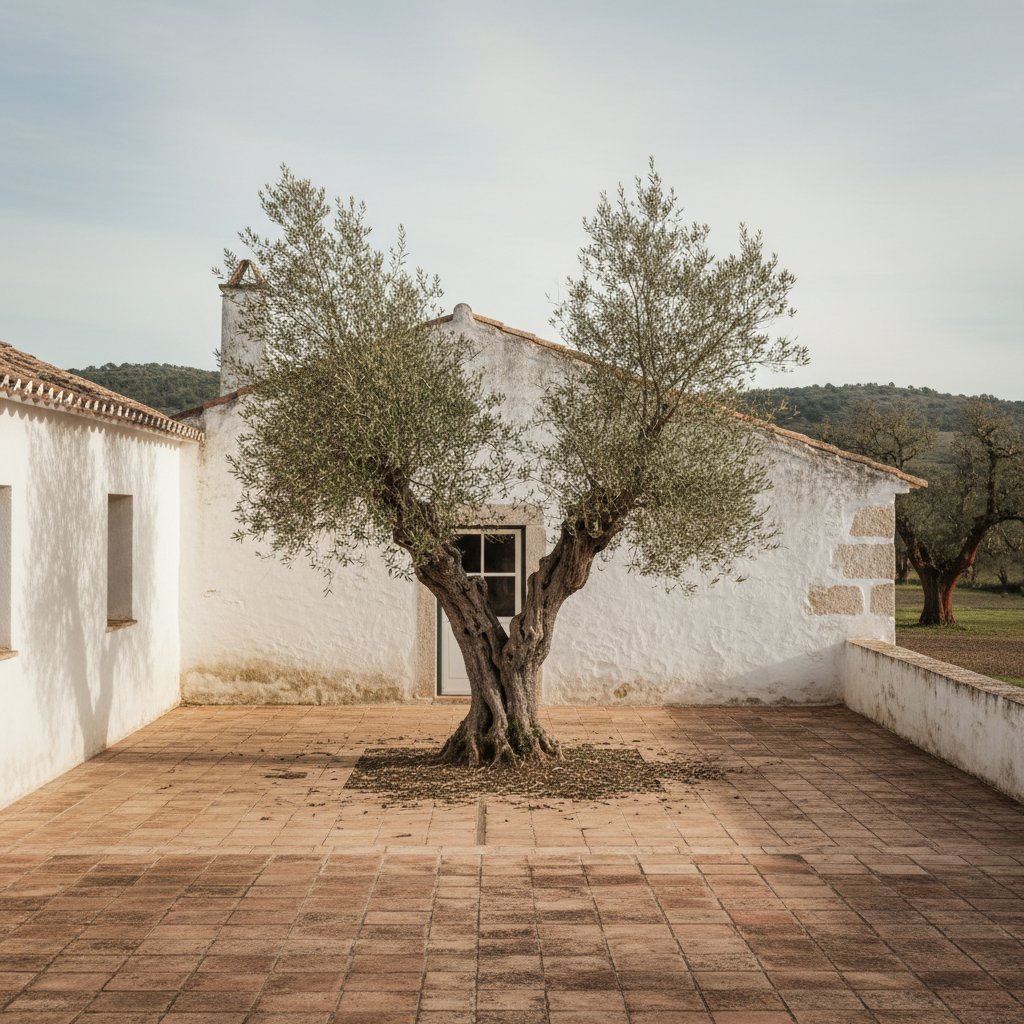
A house in a great landscape is a kind of punctuation. It imposes a full stop on the rolling sentence of the land, creating a space of exception. Within its walls, life is ordered, protected, and private. Outside, the world continues on its own terms, subject to the sun, the wind, and the slow turn of the seasons. The question for any architect or dweller is how these two states should meet.
In the sun-baked plains of Alentejo, Portugal, the answer is often found in the terrace. Not a deck, nor a patio in the suburban sense, but a room in its own right. It is a third room, poised between the interior and the exterior, belonging fully to neither but serving as a crucial link between them. It is perhaps the most important room of all.
Here, the floor is often made of rustic clay tiles or stone, cool in the morning and holding the day’s warmth long after the sun has set. The ceiling is the vast, open sky. Its walls might be low, whitewashed partitions, the trunk of an ancient olive tree, or simply the perceived edge where the managed space of the home gives way to the wilder land beyond.
The purpose of this space is not merely transitional. It is a place of deep habitation. It is where morning coffee is taken, where meals are shared under the shade of a reed-covered pergola, and where one sits quietly in the evening to watch the light fade over the cork oak forests. It is an extension of the life of the home, lived in the open air.
It is a room with the sky for a ceiling and the horizon for a wall.
This architectural gesture acknowledges a fundamental truth of living in a place like Alentejo: the climate is not something to be defeated, but something to be lived with. The house provides shelter from the extremes of heat and cold, but the terrace provides a space to experience the temperate, life-giving moments in between.
The Civilized Threshold
Unlike the modern ambition of seamless indoor-outdoor living, with its vast panes of glass that seek to erase the boundary, the traditional terrace maintains a gentle, honest separation. It is a threshold, but a wide and generous one. To be on the terrace is to be at home, yet also to be fully in the landscape.
It offers a position of prospect. From the vantage point of the terrace, one can observe the land, feel the breeze, and hear the sounds of the countryside without being entirely subsumed by it. It frames the view, editing the vastness of the landscape into a series of calm, composed pictures.
This space teaches a quiet lesson in how to live. It suggests that comfort does not require total enclosure, and that a connection to nature does not require a complete surrender to it. It is a middle ground, a place of balance and contemplation.
The terrace is the heart of the simple house, a testament to an architecture that serves life not by imposing itself, but by creating the conditions for a richer, more thoughtful existence. It is a design that arises from the land itself, and from a deep understanding of what it means to live there.
Further reflections on the vernacular architecture of the region, accompanied by plates and a directory of Alentejo, Portugal, are available in Edition I of the journal.
The longer reading lives in the magazine.
This essay is one observation. Edition I carries the plates, the studies and the directory of Alentejo, Portugal — thirty pages, on uncoated stock, posted across Europe.
Continue reading
All essays → Editorial · 8 min
What a house is worth, and what it costs
On the difference between price and value, and why we have stopped using the first to describe the second.
 Markets · 11 min
The quiet market
Why the most interesting European homes are no longer listed, and what that means for the people looking for them.