Five Plants for the Andalusian Patio
The quintessential Spanish courtyard is a carefully orchestrated arrangement of plant life, designed for shade, scent, and survival against the southern sun.
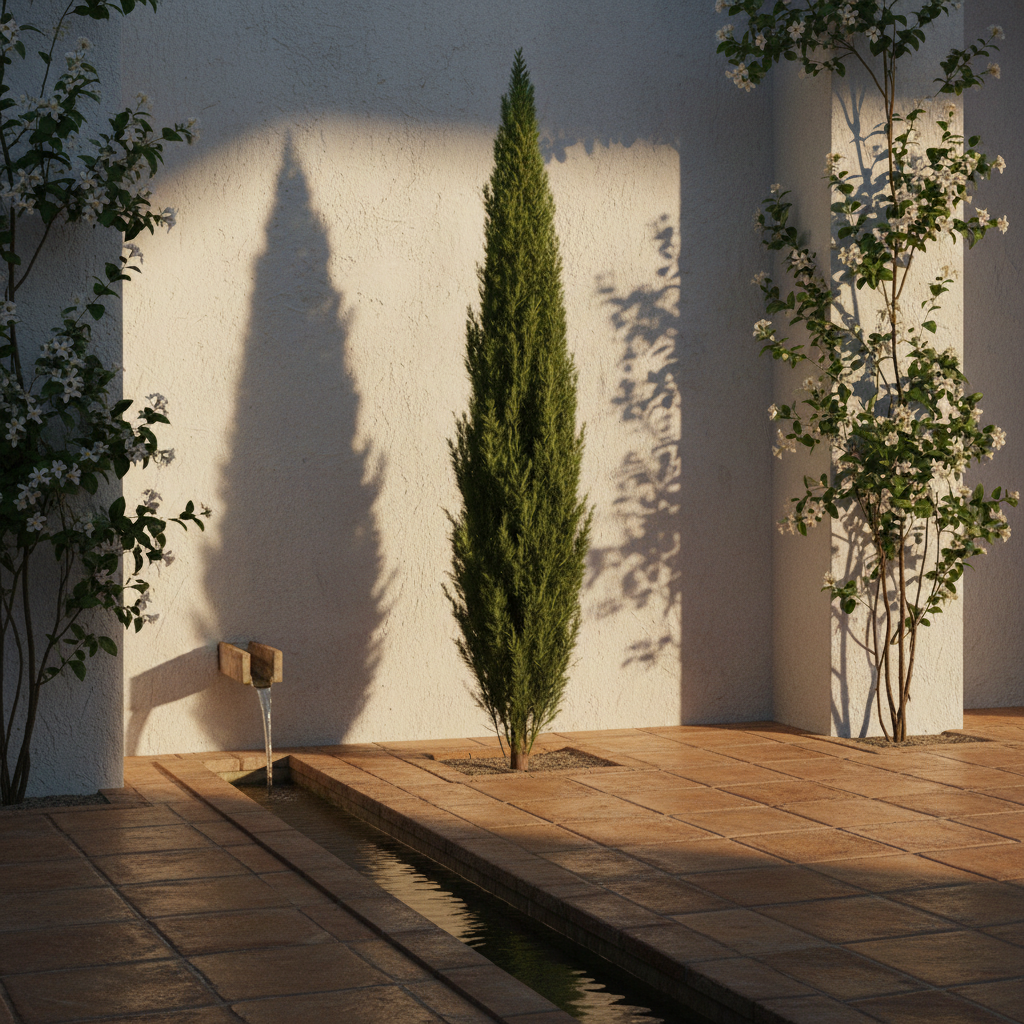
The Andalusian patio is an architectural answer to a question asked by the sun. Its origins are a study in layers, from the Roman peristyle courtyard to the enclosed gardens of Al-Andalus, but its function has remained constant: to create a temperate and private world away from the blaze of the street. This is not achieved with masonry alone. It is a work of horticulture, a space made habitable by plants.
To step into a well-considered patio is to experience a deliberate sequence of sensations. The first is often a change in temperature, a coolness that rises from the stone and earthenware. The second is the scent—the specific perfume of a place, carried on the still air. This sensory architecture relies on a careful selection of plants, each chosen for a distinct role in the conspiracy against the heat.
The most visible role is often played by the climbers. Jasmine is the classic choice, its small white flowers releasing an intense perfume in the evening. Bougainvillea offers a more riotous, papery color. These plants are tasked with scaling the walls, creating a living tapestry that absorbs light and drapes the hard planes of architecture in soft foliage. They are the first line of shade, the fragrant ceiling of the outdoor room.
At the center of the space, structurally and symbolically, is the tree. Traditionally, this is a citrus—an orange or lemon—whose glossy, dark leaves provide a dense canopy of shade. The citrus is a generous anchor, offering scented blossoms in the spring and fruit in the winter, connecting the enclosed patio to the agricultural landscape of the region. It is the primary source of shade, the sturdy tentpole of the entire arrangement.
The Andalusian patio is a conversation between architecture and horticulture, a pact made against the heat.
Color is used with intention, often as a vibrant accent against the whitewashed walls. This is the work of the geranium. Clustered in terracotta pots on the floor or mounted in brilliant rows on the walls, their bright reds and pinks provide a necessary punctuation. They are the most famous residents of the patio, but their role is that of a supporting actor—a joyful, human-scale splash of life.
The Sensory Blueprint
Beyond sight, the patio is designed for touch and smell. This layer is provided by herbs, typically rosemary or lavender, grown in smaller, accessible pots. Brushing past them releases their essential oils, a brief, clean scent that mingles with the sweeter jasmine. These are functional plants, tied to the kitchen and the landscape, that add a textural and aromatic depth to the space.
The final element is architectural, a plant chosen for its form. The slender, columnar cypress is the perfect counterpoint to the spreading canopy of the citrus tree. It provides a strong vertical line, a dark green accent that draws the eye upward and introduces a note of formal sobriety. It is a living sculpture that holds its form against the bright sky.
Together, these five archetypes—climber, tree, flower, herb, and pillar—create a complete and self-sustaining ecosystem. They are a masterclass in vernacular design, a system perfected over centuries to solve the problem of a hot, dry climate. The beauty is not incidental; it is the direct result of a deep and practical understanding of how to live well in a specific place.
The full study of the Andalusian patio, with plates and a directory of the region, lives in Edition II of our journal.
The longer reading lives in the magazine.
This essay is one observation. Edition II carries the plates, the studies and the directory of Andalusía, Spain — thirty pages, on uncoated stock, posted across Europe.
Continue reading
All essays → Editorial · 8 min
What a house is worth, and what it costs
On the difference between price and value, and why we have stopped using the first to describe the second.
 Markets · 11 min
The quiet market
Why the most interesting European homes are no longer listed, and what that means for the people looking for them.