Five Winters in a Portuguese Farmhouse
We have forgotten that a renovation need not be a race against a clock of our own making.
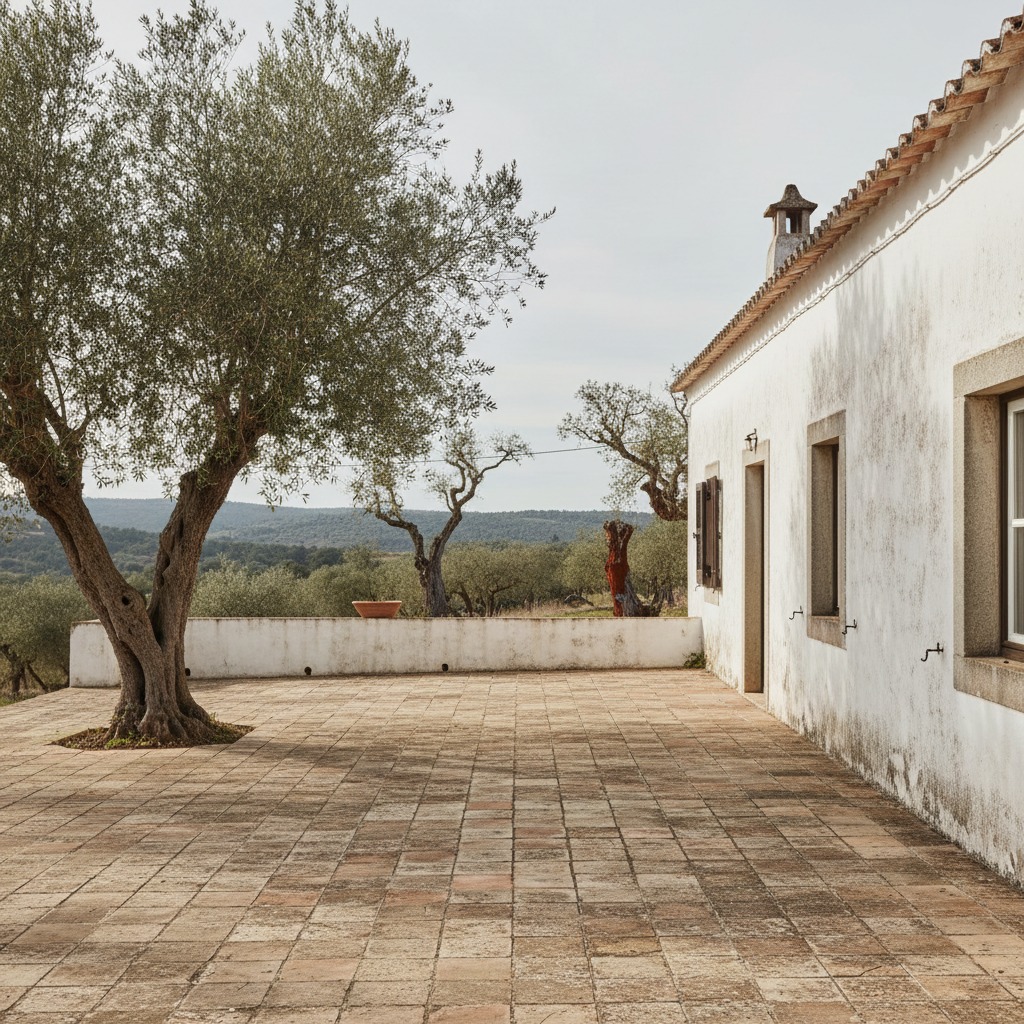
The contemporary imagination pictures renovation as a blitz. A flurry of demolition, dust, and frantic decision-making, all compressed into a tight, marketable timeline. The goal is a swift transformation, a dramatic before-and-after suitable for a two-minute video. The process is a necessary evil to be endured for the sake of the result. We approached the restoration of a rural monte in Alentejo with a different organizing principle: five winters, not five months.
The house, when we found it, was not a ruin. It was a simple, sturdy structure of whitewashed earth and stone that had been left to itself for some years. Its windows were small, its rooms were dark, and its roof was a mosaic of mismatched tiles. But it held the quiet integrity of a building that had been shaped by necessity and the landscape itself. It sat among cork oaks and olive groves, observing the slow turn of the seasons.
The decision to work only in winter was, in part, a practical one. The Alentejo sun is relentless in summer, ill-suited to the hard labor of construction. But it was also a philosophical choice. We wanted to learn the house in its quietest state, to understand its relationship with the low light and the cool, damp air before making any significant changes.
That first winter, little was done. We repaired a few windows, cleared the overgrown courtyard, and spent weeks simply sitting in the rooms, watching the light move across the rough plaster walls. We learned where the drafts came from, which floors were coldest, and how the sound of the rain on the roof varied from one room to the next. The house began to feel less like a project and more like a presence.
A house, like a person, reveals its character slowly, and only to a patient observer.
This was not an exercise in romantic inefficiency. It was a deliberate calibration of pace. To live within a space while restoring it is to enter into a dialogue with it. The rushed schedule of a conventional renovation leaves no time for this conversation. It imposes a vision upon a building, often at the expense of the building’s own logic.
The Rhythm of Repair
In the second winter, we rebuilt the terrace. In the third, the roof. Each task was a discrete season of work, a meditation on a single material—terracotta, timber, lime. The work was slow and methodical, dictated by weather and the availability of local craftspeople who understood these materials not as historical artifacts, but as living components of a regional vernacular.
This unhurried process stands in stark contrast to the modern cult of the makeover. Our culture is conditioned to expect instant gratification, and the renovation industry has packaged this expectation into a compelling, if hollow, narrative of transformation. The long, quiet, and often tedious middle of a project—the “during”—is edited out.
What is lost in this abridged version is the relationship that forms through sustained effort. When you spend a month mixing and applying lime plaster by hand, you develop an intimacy with the material and the wall it covers. You learn its texture, its smell, how it breathes with the changing humidity. The building ceases to be an object and becomes a collaborator.
The house is finished, in a conventional sense. The roof is sound, the walls are plastered, and the rooms are warm in winter. But the project does not feel over. A house kept this simply, and restored this slowly, is not a static object. It is an ongoing practice of inhabitation and care, a conversation that will continue for as long as we are here.
The full study of the Alentejo house, with architectural plates and a regional directory, is available in Edition I of the journal.
The longer reading lives in the magazine.
This essay is one observation. Edition I carries the plates, the studies and the directory of Alentejo, Portugal — thirty pages, on uncoated stock, posted across Europe.
Continue reading
All essays → Editorial · 8 min
What a house is worth, and what it costs
On the difference between price and value, and why we have stopped using the first to describe the second.
 Markets · 11 min
The quiet market
Why the most interesting European homes are no longer listed, and what that means for the people looking for them.