On Brunello and the Ageing of Houses
In the hills of Tuscany, the deliberate aging of Brunello wine offers a lesson in the patient transformation of our homes.
To drink a glass of Brunello di Montalcino is to taste the passage of time. The wine, a celebrated Sangiovese from a small Tuscan hill town, is governed by some of the most stringent production regulations in Italy. By law, it cannot be sold until five years after the harvest, with a minimum of two of those years spent in oak barrels. For the Riserva, the timeline extends to six years. This is not a wine made in haste.
This legally mandated patience is a counter-cultural act in a world that prizes speed and novelty. It insists that some things of quality cannot be rushed; they require a slow, deliberate conversation with their container and their environment. The barrel, the bottle, the cellar—these are not passive vessels but active participants in the wine’s becoming. They are the architecture of its character.
Over years, the wine’s tannins soften. Its bright, youthful fruit notes deepen into more complex, tertiary aromas of leather, earth, and dried cherry. It is a controlled, intentional transformation. The winemaker does not fight the ageing process but guides it, understanding that the very qualities that make Brunello exceptional are born of this slow, oxidative journey.
Brunello is a meditation on time. It does not shout; it slowly reveals itself.
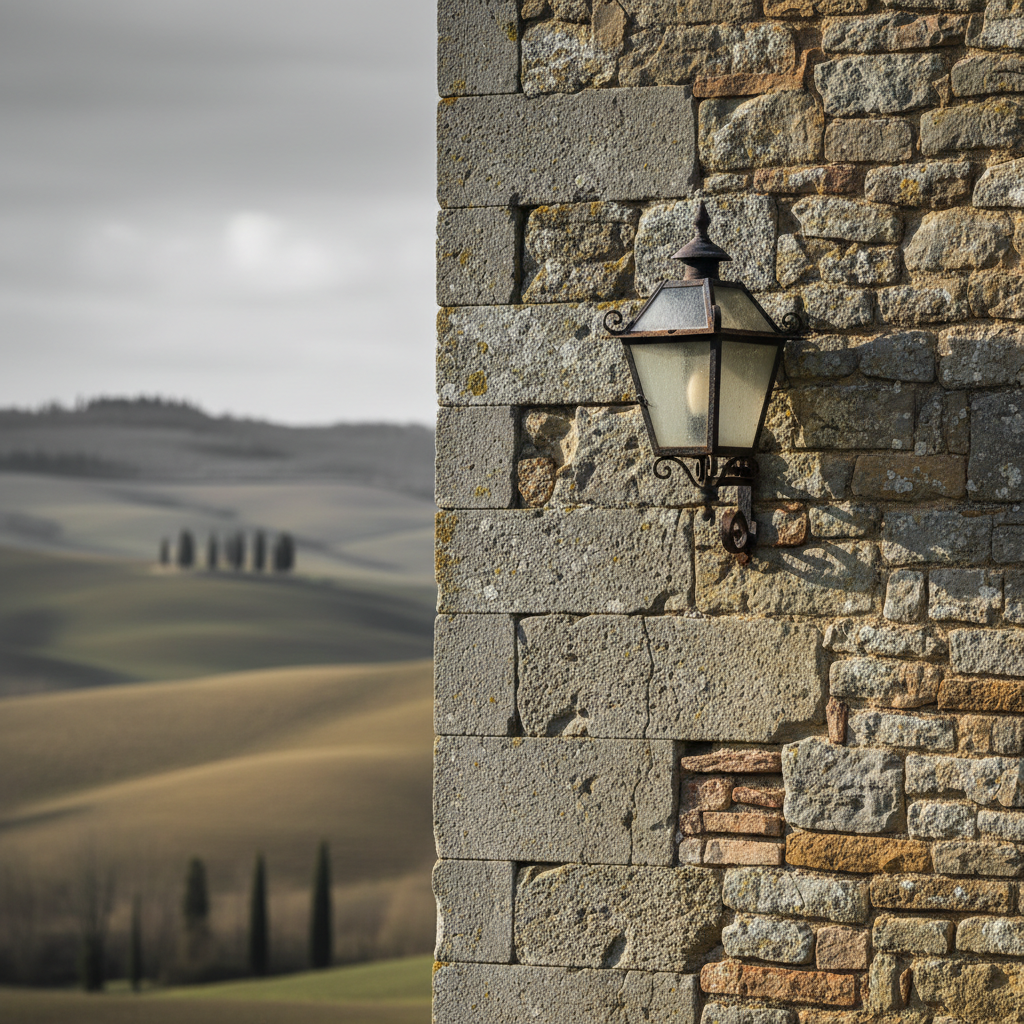
This deliberate process of maturation finds a parallel in the vernacular architecture of the region. The stone farmhouses and villas of Tuscany were not built for a single generation but for centuries. They were assembled from the land itself—local stone, timber, and clay tiles fired under the same sun that ripens the Sangiovese grapes.
The Patina of Place
Like the wine, these houses were made to age. Their materials were chosen for their durability and their capacity to improve with time. The stone walls, often assembled with little or no mortar, settle into the landscape. The terracotta floors accrue a patina from generations of footfalls. The timber beams darken and cure, growing stronger as they shed their initial moisture.
A well-built house, like a well-made wine, breathes with its environment. It absorbs the sun, withstands the winter winds, and wears the seasons upon its surfaces. This is not decay, but a form of ripening. It is the accrual of story, the physical manifestation of a life lived within its walls.
We have, in many ways, lost this appreciation for the slow work of time. Modern construction often prizes the pristine and the immediate, using materials that are designed to resist a natural patina, or which degrade ungracefully. We are taught to see ageing as a problem to be solved, not a process to be inhabited.
The lesson of Brunello is a quiet one. It suggests that the highest form of quality is not a static state of perfection, but a graceful evolution. It teaches us to see the value in things that are built to last, to appreciate the beauty of a surface that has been touched by time, and to find character in the inevitable marks of a long and useful life.
The longer reading on the patience of stone, with plates and a directory of Tuscany, Italy, is available in Edition III of the magazine.
The longer reading lives in the magazine.
This essay is one observation. Edition III carries the plates, the studies and the directory of Tuscany, Italy — thirty pages, on uncoated stock, posted across Europe.
Continue reading
All essays → Editorial · 8 min
What a house is worth, and what it costs
On the difference between price and value, and why we have stopped using the first to describe the second.
 Markets · 11 min
The quiet market
Why the most interesting European homes are no longer listed, and what that means for the people looking for them.