On Keeping a House in Alentejo
To renovate a farmhouse in five winters, not five months, is to learn the land by watching it closely.
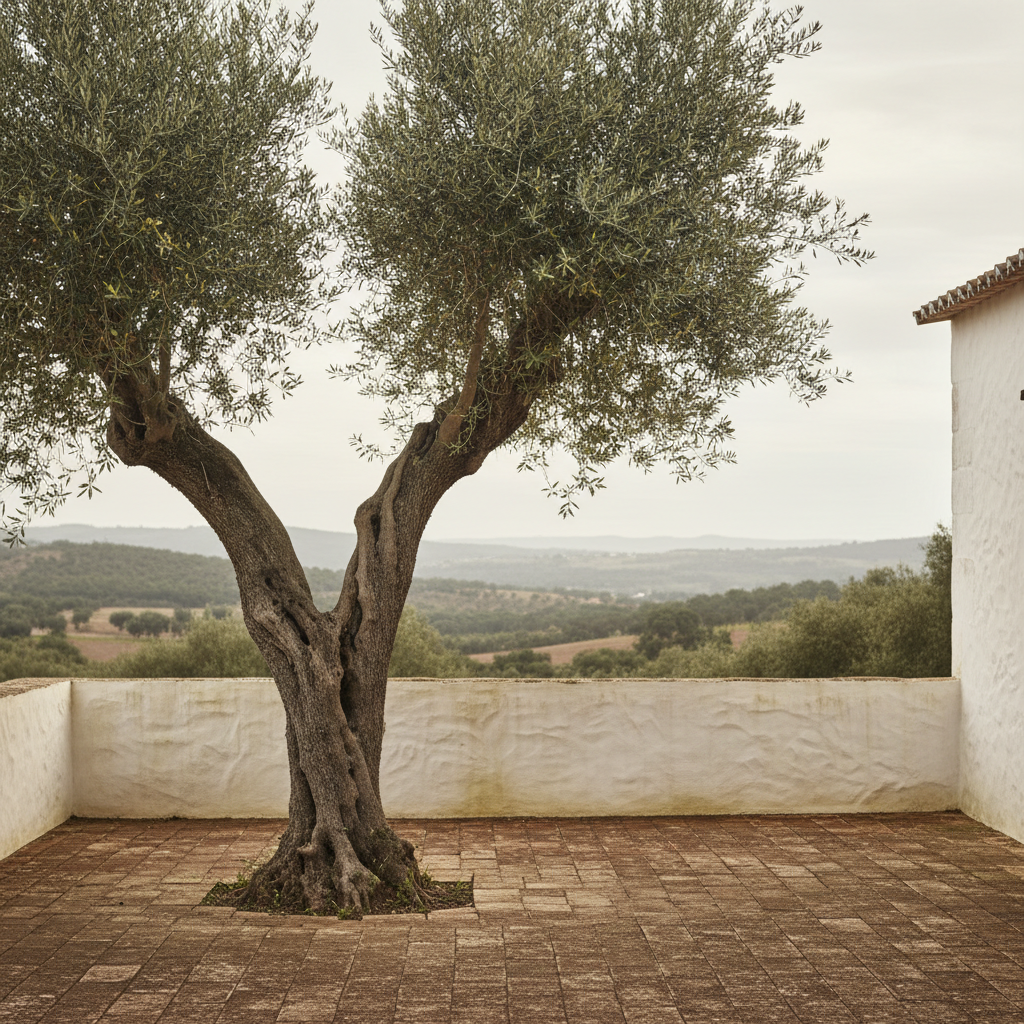
The road to the house is unpaved. After five or six kilometres, it slows to a dirt track that winds through cork oaks and olive groves, opening eventually onto a valley of soft, rolling hills. It is here, in the lowlands of Alentejo, Portugal, that a certain kind of quiet persists. The house sits low on its foundations, a whitewashed structure of stone and lime that has settled into the landscape over a century.
When we arrived for our first winter, the roof was in a state of managed collapse. Tiles were missing, and the cane underlay had grown brittle. Rain found its way into the north-facing rooms, leaving dark, geologic stains on the walls. The windows, framed in flaking blue paint, were swollen shut. It was a place held together by inertia and memory, beautiful in its decay but resisting habitation.
The impulse, common to any city-dweller who dreams of a rural escape, is to begin at once. To hire a team, draw up plans, and impose a new order on the old structure. We held this impulse at arm’s length. Our ambition was not to build a new house on the bones of the old one, but to feel our way into its logic, to understand the cadence of its life.
We decided to proceed slowly, season by season. Our timeline was not one of months, but of winters. We would come for the cold, wet season, when the land was dormant and the work of rebuilding felt like a form of hibernation. Each year, we would choose one part of the house and tend to it.
To move slowly is to notice things. It is to see how the light falls in a room in December, and how it differs in February.
The first winter was dedicated to the roof. We learned the vocabulary of the local materials: the cane harvested from riverbeds, the hand-formed "telha" tiles that give the region its character. The work was methodical, repetitive. Each tile was laid by hand, each cane stalk tied with wire. From the roof, we could see the whole of the valley, the way the mist collected in the low places in the morning.
The Rhythm of Repair
The second and third winters were for the walls and windows. We mixed our own lime plaster, a messy, forgiving process that left our hands caked in white. We learned to live with the house in a state of partial repair. One room would be finished, clean and warm, while the next remained a dusty shell. This juxtaposition was a reminder that restoration is a process, not an event.
In the fourth winter, we turned our attention to the land itself. We cleared the overgrown cistern, rebuilt its stone walls, and planted a small garden of drought-tolerant herbs. The work was less about construction and more about cultivation. We were not just building a dwelling, but tending a small piece of an ecosystem that had its own rhythms, its own stubborn vitality.
By the fifth winter, the house was transformed. Not by a grand redesign, but by a thousand small acts of attention. It was, and is, a simple place. The floors are uneven. The walls are not perfectly plumb. But it is a house that feels known, that has been listened to. It holds the memory of our winters, the quiet labour of our hands.
There is another way to do this, of course. A faster, more efficient way. But in the rush to completion, something is often lost. The slowness was the point. It was in the waiting, the watching, the gradual accretion of effort, that the house revealed itself to us. It taught us a different way of inhabiting a place: not as its masters, but as its students.
The longer reading of this story, with plates and a directory of resources in Alentejo, Portugal, is available in Edition I of our journal.
The longer reading lives in the magazine.
This essay is one observation. Edition I carries the plates, the studies and the directory of Alentejo, Portugal — thirty pages, on uncoated stock, posted across Europe.
Continue reading
All essays → Editorial · 8 min
What a house is worth, and what it costs
On the difference between price and value, and why we have stopped using the first to describe the second.
 Markets · 11 min
The quiet market
Why the most interesting European homes are no longer listed, and what that means for the people looking for them.