On Tuscan Ironwork, and What It Holds
In the Tuscan countryside, the smallest iron details often tell the longest stories of a home’s life and care.
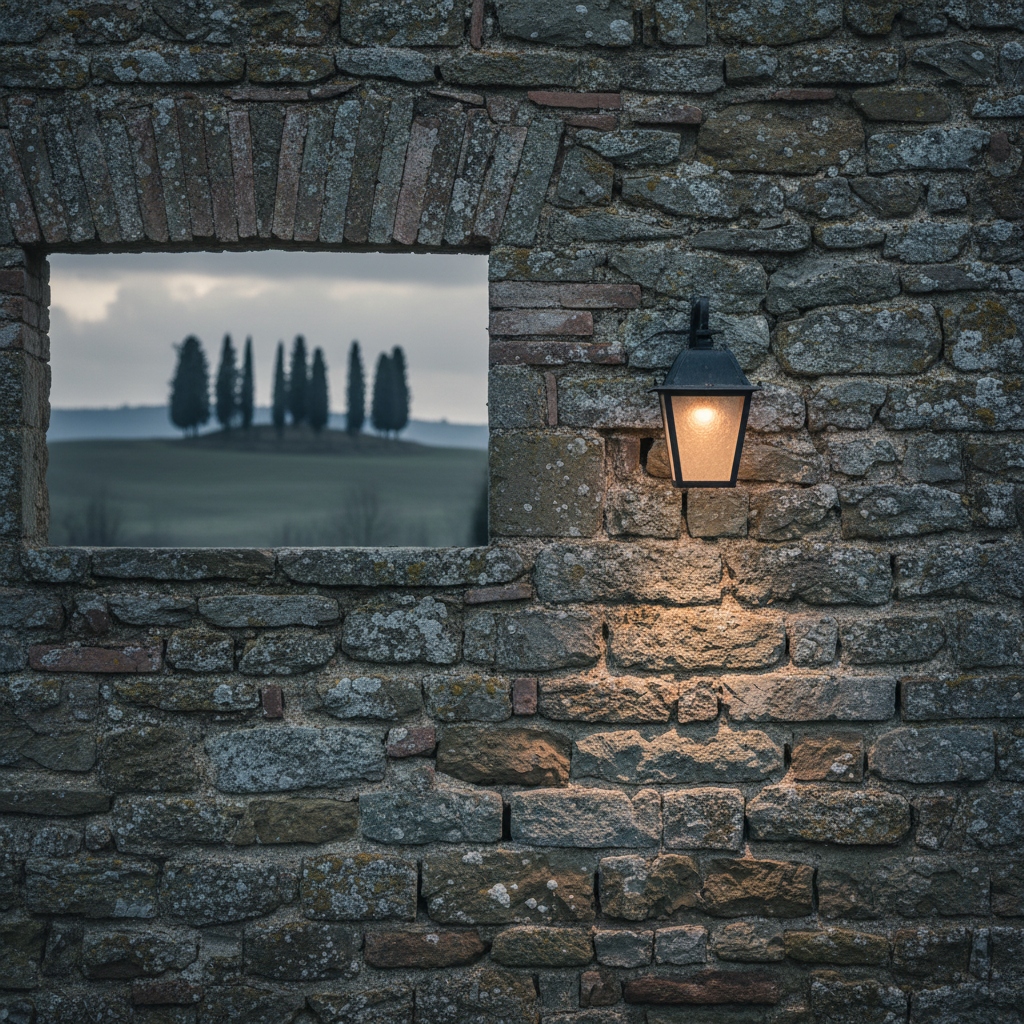
The popular image of a Tuscan farmhouse is one of elemental simplicity. It is a structure of stone and timber, rising from the earth with a kind of geological inevitability. We see these houses as monolithic, enduring, and ancient, their character defined by the grand, patient surfaces of their walls and the gentle slope of their terracotta roofs. We admire their fortitude, their seemingly passive resistance to the passage of time.
This perception is not wrong, but it is incomplete. It overlooks a quieter, more articulate language spoken by these buildings. The true story of a house—not just its age, but its life, its present state of grace—is often told in its smallest components. In Tuscany, this story is frequently written in iron.
To walk the rural lanes of the Val d'Orcia or the Chianti is to find a landscape punctuated by these modest details. They are rarely the focus of attention. They are the hinges of a heavy cypress door, the grates over a ground-floor window, the tie-rods that brace a wall, or the simple rings used for tethering a horse, now long gone. These are not grand gestures of architecture, but humble points of service.
This hardware is almost always wrought iron, or *ferro battuto*. It is a material that shares an elemental spirit with the stone it serves. Unlike cast iron, which is poured into a mold, wrought iron is heated and hammered into shape by a blacksmith. Each piece is therefore unique, bearing the marks of its creation. The hammer blows remain visible on its surface, a subtle texture that speaks of force, intention, and human effort.
Iron, in this context, is not an accent but a bond. It is the modest stitch that holds the larger garment together.
Its function is primarily one of connection and security. An iron strap secures a timber beam. A set of *cardini*, or pintle hinges, allows a heavy door to pivot. An *inferriata*, or window grille, provides security while allowing for the passage of air and light. These pieces are not ornamental additions; they are integral, working parts of the home’s structure.
A Mark of Intention
Observing the condition of this ironwork reveals a great deal about a property. Rust is, of course, a natural state for iron. But there is a difference between the noble patina of age and the deep, flaking corrosion of neglect. A well-kept house will show its ironwork cared for—cleaned, perhaps sealed with wax, and repaired when necessary.
Here, one might find a centuries-old hinge working alongside a discreet, modern weld—a sign that the piece has been tended to across generations. This is not a bid for historical purity, but an act of continuity. It is an acknowledgment that a house is not a static object to be preserved in amber, but a living entity that requires ongoing partnership.
The presence of this cared-for iron speaks to a certain mindfulness. It suggests an owner who understands that the integrity of the whole depends on the soundness of its parts. To allow a hinge to seize or a window latch to fail is to begin a slow process of unraveling. To maintain it is to affirm a commitment, to participate in the slow, patient work of keeping a house.
These small fixtures are a testament to the fact that a home is made not only of its large, visible masses, but also of its precise, functional details. The stone walls provide the shelter, but the ironwork allows the house to be opened and closed, secured and lived in. It is the interface between the edifice and the inhabitant.
The full expression of this relationship between material and maintenance lives in the pages of our work. The longer reading on the patience of stone, with plates and a directory of Tuscany, Italy, is available in Edition III of the journal.
The longer reading lives in the magazine.
This essay is one observation. Edition III carries the plates, the studies and the directory of Tuscany, Italy — thirty pages, on uncoated stock, posted across Europe.
Continue reading
All essays → Editorial · 8 min
What a house is worth, and what it costs
On the difference between price and value, and why we have stopped using the first to describe the second.
 Markets · 11 min
The quiet market
Why the most interesting European homes are no longer listed, and what that means for the people looking for them.