The Courtyard and the Cathedral
The Andalusian home quietly inherited its logic not from a palace or a fortress, but from a mosque.
To stand inside the Mezquita-Catedral of Córdoba is to stand within an idea. The building, famously a mosque before it was a cathedral, does not present a singular, vaulted interior designed to draw the eye upward. Instead, it offers a forest of columns. Hundreds of slender pillars branch into a repeating canopy of two-tiered arches, creating a space that feels both immense and intimate, rhythmic and quiet.
It is an architecture of repetition, not singularity. The effect is one of profound tranquility, a sprawling yet shaded interior that diffuses light and muffles sound. One does not feel small, as in a Gothic cathedral, but rather held, part of a pattern that extends in every direction. This method of organizing space—of creating a large, covered expanse by multiplication rather than by scale—is the great architectural lesson of the Mezquita.
This lesson, however, did not echo loudest in the region’s subsequent churches or public monuments. Its most faithful student was the Andalusian house.
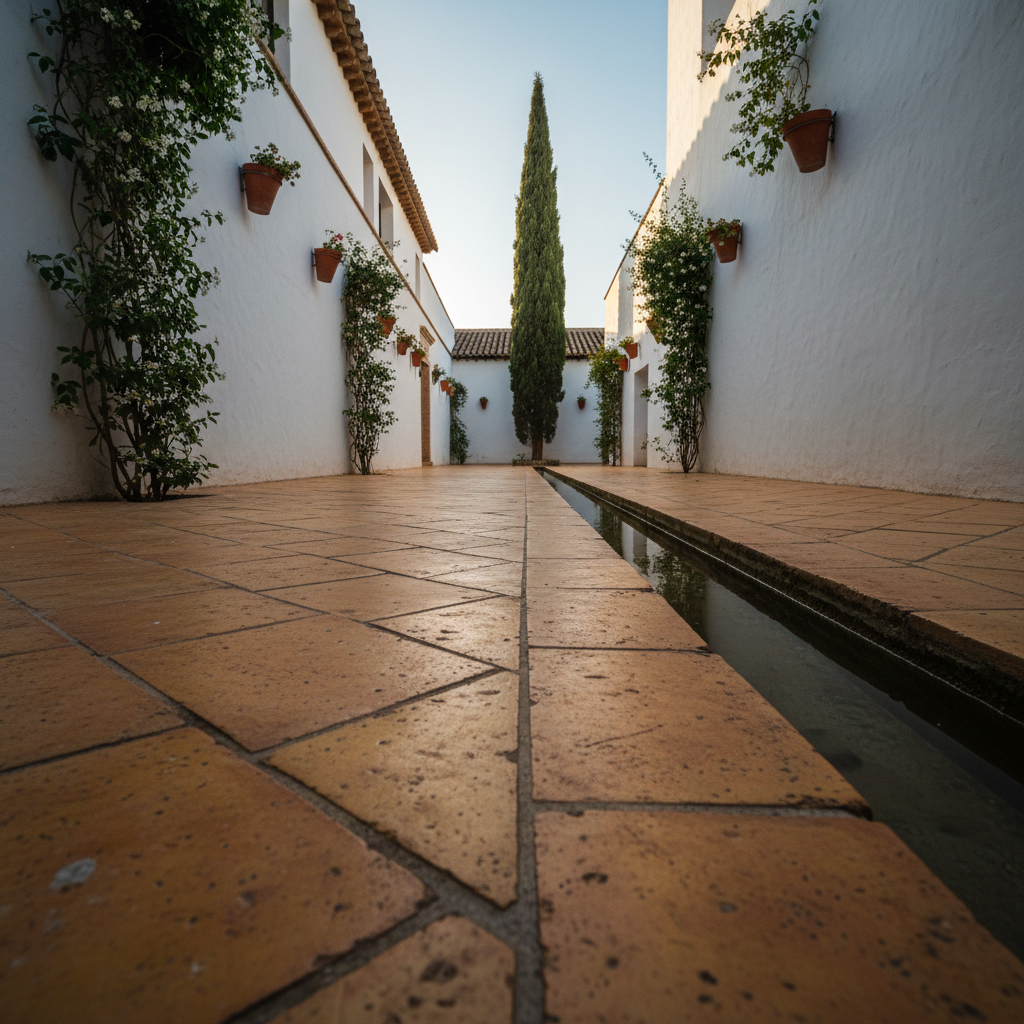
Across the sun-bleached landscapes of southern Spain, from Córdoba to Seville, the home is organized around a central, open-air courtyard, or *patio*. This is not a garden appended to a house, nor a backyard for recreation. The patio *is* the house. It is the primary room, the void around which all other rooms are arranged. It is a direct, if unconscious, descendant of the Mezquita’s spatial logic.
The home does not surround the courtyard; it serves it.
The connection is one of sensibility. The architects of these homes, built over centuries, understood the same fundamental truths as the builders of the great mosque. They knew the value of shade, the cooling power of stone and plaster, the restorative sound of water, and the peace that comes from an enclosed, private world.
The Grammar of Shade
In a climate where the summer sun is an antagonist, the courtyard becomes a sophisticated machine for living. Its high, often windowless exterior walls present a formidable defense against the heat. Inside, the open-air core acts as a thermal chimney, drawing warm air up and away while pulling cooler air down into the living spaces. The arcades and covered walkways that ring the patio create a gradient of light and temperature, a gentle transition from the bright center to the cool, dark rooms beyond.
Life in these homes is lived in the open, yet hidden from the street. The courtyard is a corridor between rooms, a dining hall on warm evenings, a sitting room in the dappled morning light. The presence of a small fountain or a simple water channel offers a constant, murmuring soundtrack that masks the sounds of the city and cools the air through evaporation. This is the grammar of the Mezquita—repetition, rhythm, shade, and water—transposed to a domestic scale.
The result is a home that breathes. It is an architecture of introversion, focused not on a grand facade to impress the public but on the quality of the life within its walls. The central patio, like the Mezquita’s columned hall, is a space for quiet contemplation and communal existence, shielded from the harshness of the world outside.
The grandest architectural statement in Andalusía, it turns out, was not a model for other cathedrals. It was a blueprint for the home. Its principles of repetition, enclosure, and climate mitigation were absorbed into the vernacular, shaping the very definition of domestic comfort in the Spanish south for a thousand years.
The longer reading, with plates and a directory of Andalusía, Spain, lives in Edition II of the magazine.
The longer reading lives in the magazine.
This essay is one observation. Edition II carries the plates, the studies and the directory of Andalusía, Spain — thirty pages, on uncoated stock, posted across Europe.
Continue reading
All essays → Editorial · 8 min
What a house is worth, and what it costs
On the difference between price and value, and why we have stopped using the first to describe the second.
 Markets · 11 min
The quiet market
Why the most interesting European homes are no longer listed, and what that means for the people looking for them.