The Courtyard Is Not a Garden
In the south of Spain, the patio has long been a sophisticated environmental device, not a mere decorative afterthought.
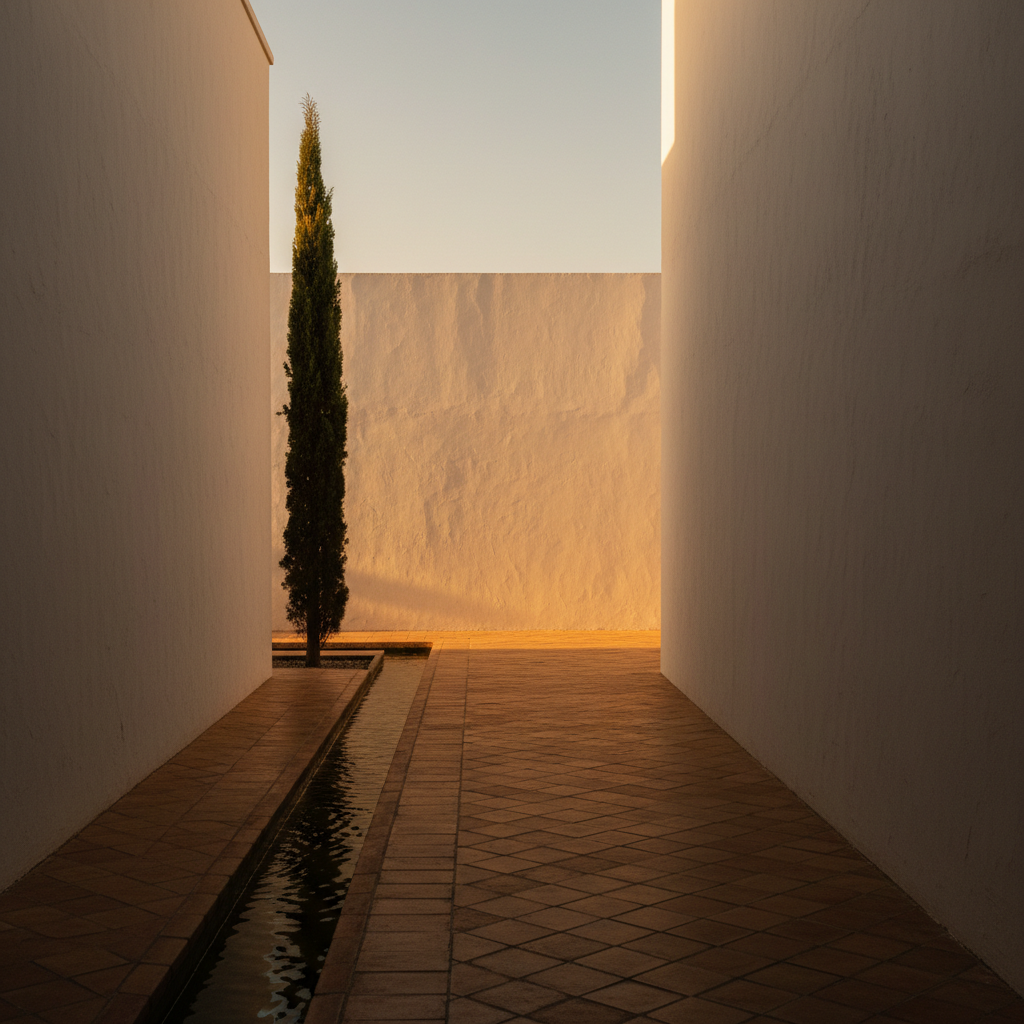
The Andalusian patio, as encountered by the modern traveler, presents an irresistible image. In Córdoba’s festival, or glimpsed through an open doorway in Seville, it is a vision of cascading geraniums, intricate tilework, and the gentle sound of a fountain. It is beautiful, photogenic, and easily mistaken for a purely decorative space—a kind of outdoor room intended for little more than visual pleasure.
This perception, however common, misses the point entirely. The patio is not an ornament; it is a machine. For centuries, before the advent of mechanical cooling, this architectural feature has served as a sophisticated and passive environmental device, central to making life tolerable in one of Europe’s hottest and driest regions. Its design is a direct and intelligent response to climate.
Its origins are ancient, a legacy of the Roman atrium and the courtyard houses of the Islamic world. The form is brilliantly simple: a void at the center of a building. This central space acts as a reservoir for cool air. During the night, cool, dense air sinks and settles into the patio. The home’s thick, heavy walls—a significant thermal mass—absorb this coolness and hold it, regulating the temperature of the surrounding rooms long into the following day.
The first line of defense against the sun is shade. The courtyard is often narrow, its proportions calculated to minimize the amount of time the floor is exposed to direct overhead sun. A single cypress or orange tree might be planted, its canopy providing a living parasol. In the fiercest months, a simple fabric awning, or *toldo*, can be drawn across the space, creating a ceiling of shade that deflects the worst of the solar radiation.
Water is the second critical element. The central fountain, or the narrow channel of a water rill, is the active heart of the cooling system. Through evaporative cooling, it humidifies the immediate environment. As the water evaporates, it draws thermal energy from the air, measurably lowering the temperature within the patio. The gentle murmur of water is not just an acoustic delight; it is the sound of the system at work.
The genius of the design is in its passive operation; it works without moving parts.
The Physics of Stillness
The materials are chosen with equal care. Porous terracotta tiles on the floor can be wetted down, releasing coolness into the air throughout the day. The ubiquitous whitewashed lime plaster on the walls is highly reflective, bouncing sunlight away from the building and preventing the walls from accumulating heat. This is not an aesthetic choice alone, but a functional one.
Even the planting is strategic. The fragrant jasmine, climbing bougainvillea, and potted ferns are not arranged as one would find in an English garden. They are selected for their ability to thrive in shade and to contribute to the microclimate through transpiration, a process where plants release water vapor, adding to the cooling effect. They are components in a living system.
In an era of modern architecture defined by glass curtain walls and a heavy reliance on powered HVAC systems, the Andalusian patio offers a quiet lesson. It demonstrates a design philosophy that works in concert with the natural environment, rather than in opposition to it. It does not fight the climate; it accommodates it, creating a haven of comfort through intelligent, passive means.
This space becomes the true heart of the home, a calm and temperate core around which daily life can organize itself, even on the most oppressive summer afternoons. Social life does not happen in spite of the heat, but because the architecture has created a place where it can flourish.
Further explorations of vernacular design and its response to the southern Spanish climate, accompanied by original plates and a directory for Andalusía, are contained within Edition II of the journal.
The longer reading lives in the magazine.
This essay is one observation. Edition II carries the plates, the studies and the directory of Andalusía, Spain — thirty pages, on uncoated stock, posted across Europe.
Continue reading
All essays → Editorial · 8 min
What a house is worth, and what it costs
On the difference between price and value, and why we have stopped using the first to describe the second.
 Markets · 11 min
The quiet market
Why the most interesting European homes are no longer listed, and what that means for the people looking for them.