The Gentle Pitch of a Tuscan Roof
The slope of a farmhouse roof in the Val d'Orcia says more about its builders than any signature.
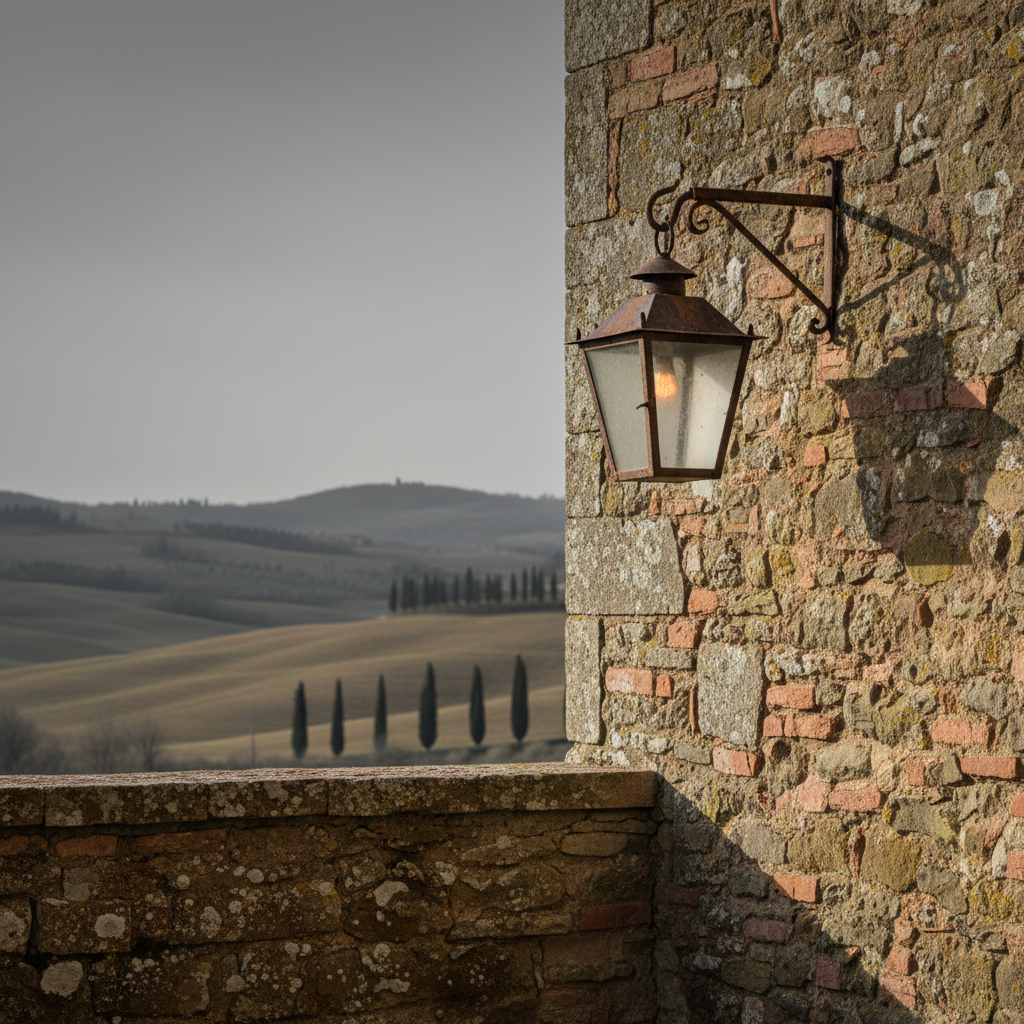
The farmhouses of the Val d’Orcia are quiet objects. Seen from a neighbouring hill, a traditional ‘podere’ is a study in geometric patience—a warm, rectilinear form settled into the land. It does not announce itself loudly. It does not posture. It simply is, and has been for centuries.
Its walls are of the earth, its windows are sparing, and its posture is low. But the building’s most subtle gesture—and perhaps its most telling—is the pitch of its roof.
The terracotta tiles, faded by sun and colonised by lichen, are set at a gentle, almost humble, angle. It is not the steep, dramatic pitch of an alpine chalet, designed to shed heavy snow. Nor is it the near-flat roof of a southern coastal dwelling, built for sun and dry air. The Tuscan roof seems calibrated to a middle way.
Its primary function, of course, is to manage rain. The slope is just steep enough to guide the seasonal rainfall of central Italy toward the ground, preventing the water from lingering. It is an effective solution, but its elegance lies in its economy. The angle is one of sufficiency, and no more.
The angle of the roof is the angle of a settled understanding.
This is where function transcends into a quiet statement of philosophy. The roofline is not an imposition on the landscape, but a response to it. It reflects a conversation with the climate, not a battle against it. An architect of a different sensibility might have over-engineered the slope for a theoretical hundred-year storm, creating a steeper, more dramatic line. But here, the builders demonstrated a confident restraint.
The Measure of Restraint
That restraint speaks to a deep, generational knowledge of place. It suggests a people who did not feel the need to build against a caricature of nature, but in partnership with its known, observable patterns. They understood the rain, the sun, the wind. They knew their materials, the heft and porosity of the local clay and timber.
To raise a roof of this pitch was to make a statement of material honesty. It used no more timber in its framing than was necessary. It required no complex engineering to support its weight. It was an act of profound resourcefulness, born not of poverty, but of a respect for labour and material.
Today, we often build with an anxious vigilance, governed by abstract codes and preparing for worst-case scenarios that may never come. We build for speed, for immediate effect, and for marketability. The old Tuscan farmhouse was built for continuity. The roofline is the very picture of this intention: calm, enduring, and without pretense.
This single architectural detail, read with care, becomes a key to understanding the culture that produced it. It is a quiet narrator of a worldview centered on patience, balance, and a long, slow symbiosis with the land.
Further observations on the material culture of Tuscany, Italy, accompanied by original plates and regional directories, are collected in Edition III of our journal.
The longer reading lives in the magazine.
This essay is one observation. Edition III carries the plates, the studies and the directory of Tuscany, Italy — thirty pages, on uncoated stock, posted across Europe.
Continue reading
All essays → Editorial · 8 min
What a house is worth, and what it costs
On the difference between price and value, and why we have stopped using the first to describe the second.
 Markets · 11 min
The quiet market
Why the most interesting European homes are no longer listed, and what that means for the people looking for them.