The Hardness of a Soft House
The contemporary wellness aesthetic, with its limewashed walls and linen rugs, proposes a life of ease that it cannot deliver.
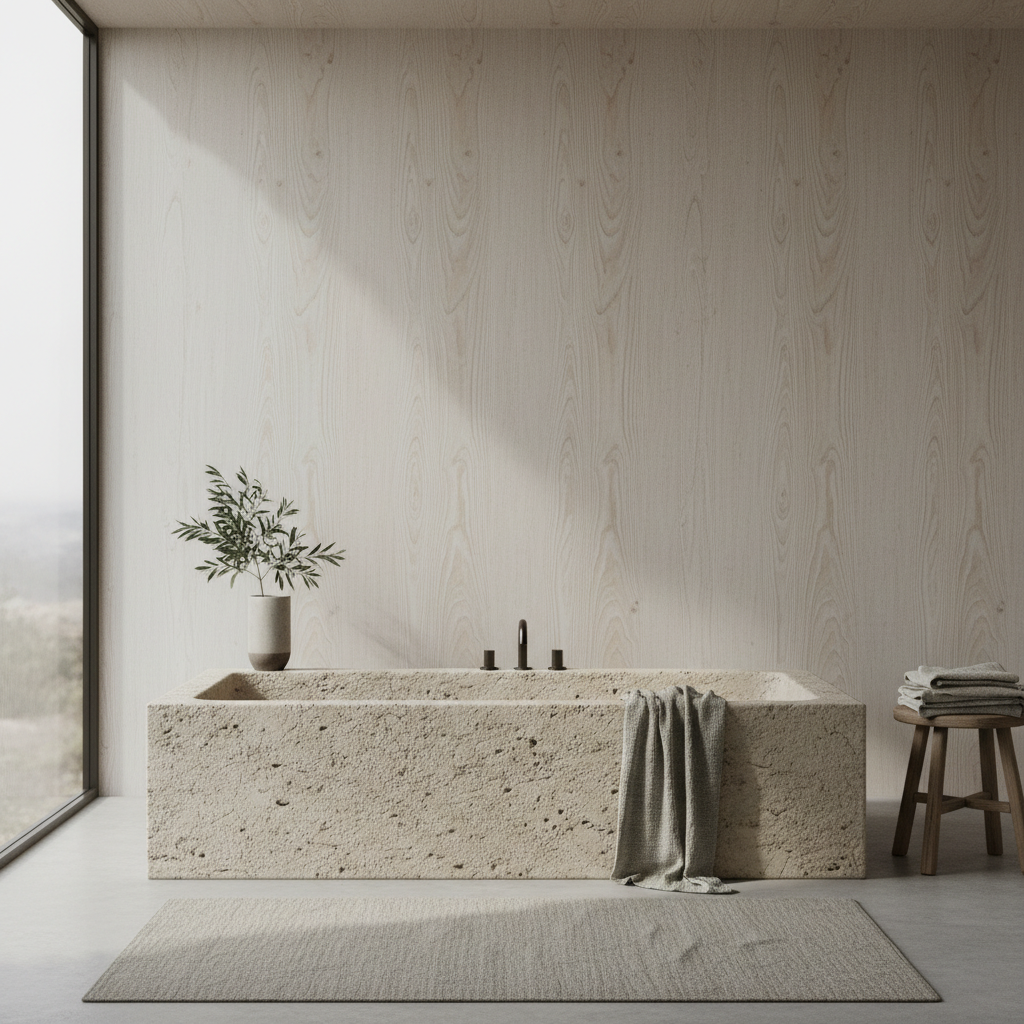
A certain kind of house has settled in the contemporary imagination. It is a space of soft textures and muted light, walls of chalky plaster, and floors of wide, pale wood. There are no sharp corners here. Light filters through linen curtains, pooling on floors softened further by undyed wool or hemp.
This is the house as a sensory retreat. It is an architecture of wellness, an answer to the noise and speed of the outside world. Every surface seems to offer a kind of tactile gentleness. It suggests a life lived with unusual calm and deliberation, a deep breath rendered in wood, stone, and woven fiber.
The appeal is elemental. These materials connect us to something ancient and handmade. Plaster and limewash have a depth and variability that cannot be replicated by a coat of flat paint. They hold the light differently. They feel, to the hand, like stone or earth. They seem to promise a more grounded way of being.
We see these spaces as a corrective to a recent past of high-gloss kitchens and polished concrete. It is a turning away from the hard, reflective planes of modernism and toward something that feels more forgiving. It is an aesthetic of quiet.
Yet, a softness to the eye can conceal a hardness in practice. The tranquil surfaces of the wellness house demand a quiet, constant tax on the owner. This is the central paradox of the aesthetic: its visual calm is purchased with a steady, low-grade hum of upkeep.
The Tax on Living
Limewash is a delicate finish, prone to streaks and water stains. Plaster, for all its textural beauty, is less resilient than common drywall, unforgiving of a misplaced chair or a child’s toy. Those linen rugs and unsealed wooden floors hold onto the evidence of every spill. This is the hardness of the soft house.
It asks for a kind of vigilance that is at odds with the very ease it is meant to inspire. The home becomes less a backdrop for life and more a central, demanding character in it. One hesitates to hang a picture; one worries over a glass of wine.
The soft house is a paradox: its visual quiet is purchased with a constant, low-grade hum of upkeep.
This is not a financial argument. While bespoke plasterwork and natural materials are considerable investments, the more significant cost is measured in attention. It is the mental energy spent on preservation, the slight, persistent anxiety about maintaining a state of perceived perfection.
An aesthetic so deeply entwined with the idea of wellness can, ironically, become a source of stress. It presents an ideal of domestic life that is ultimately theatrical—beautiful to behold, but difficult to inhabit. True sanctuary, perhaps, is found not in the curation of flawless surfaces, but in the freedom to be imperfectly at home.
The pursuit of a softer, more considered environment is a worthy one. But it requires an honest accounting of what is asked of us in return. This observation, and the quiet tax on a certain kind of living, is a matter of continued interest.
The longer reading lives in the magazine.
This essay is one observation. Edition V carries the plates, the studies and the directory of Across Europe — thirty pages, on uncoated stock, posted across Europe.
Continue reading
All essays → Editorial · 8 min
What a house is worth, and what it costs
On the difference between price and value, and why we have stopped using the first to describe the second.
 Markets · 11 min
The quiet market
Why the most interesting European homes are no longer listed, and what that means for the people looking for them.