The Heart of the House Is a Hearth
In the vast plains of Alentejo, the kitchen eschews performance for presence, remaining the quiet, essential center of the home.
The modern kitchen is a stage for performance. It is a well-lit production of polished stone, integrated appliances, and sculptural faucets, each component chosen to communicate a certain taste. It is a room that is often more showroom than workshop, a testament to what is possible rather than a reflection of what is practiced.
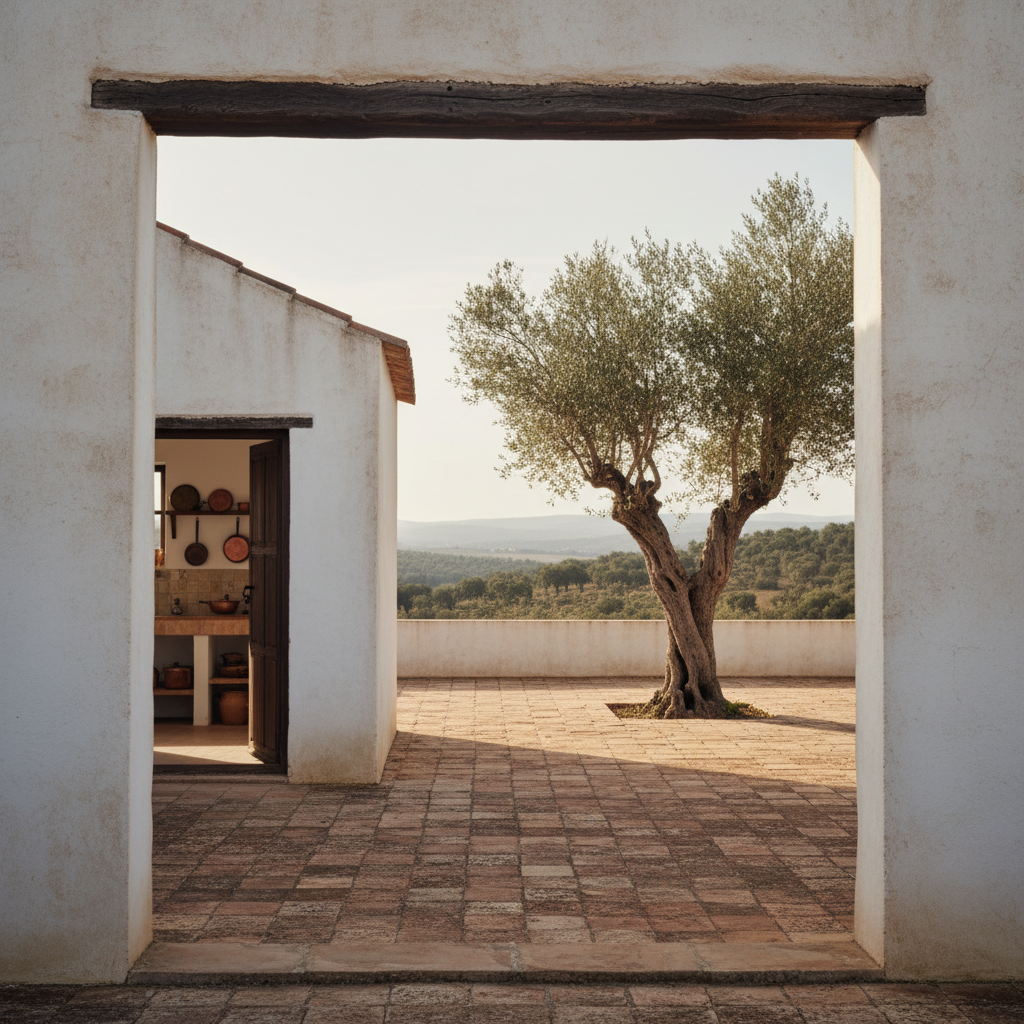
This room is a stranger in the plains of Alentejo. Here, in the sun-baked heart of Portugal, the kitchen serves a different purpose. It is not a stage, but a hearth. It is not a statement, but a space. Its value is not measured in materials or technology, but in the quiet sustenance it provides.
To enter an Alentejan kitchen is to step into the house’s center of gravity. It is often the simplest room, composed of whitewashed walls, a worn wooden table, and a collection of mismatched chairs. There is no island, no bank of uniform cabinetry, no hushed, handleless fridge. There is, instead, a deep stone sink, a wood-fired stove, and shelves holding the daily implements of cooking: clay pots, a chipped ceramic jug for olive oil, thick glassware.
The air is cool, a respite from the dry heat of the countryside. It might carry the scent of woodsmoke, of garlic frying in oil, or of bread baking. These are the smells of a working room, a place of constant, low-level activity. It is a space designed not for presentation, but for living.
The Alentejo kitchen does not announce itself; it simply is, as fundamental and unassuming as the cork oaks dotting the landscape.
It is a room that betrays a different set of priorities. Its beauty is incidental, a by-product of its utility. The patina on a copper pot, the scored surface of a cutting board, the organic shape of a hand-thrown bowl—these are not aesthetic choices. They are the marks of use, the accumulation of meals and years.
A Space of Quiet Utility
This approach is not a rejection of the new, but an adherence to the necessary. Technology is welcome where it serves a purpose without disrupting the room’s fundamental character. A modern oven might replace a more primitive hearth, but it will not become the kitchen’s focal point. The center remains the table, the place of gathering.
The Alentejo kitchen is a space of economies. Nothing is wasted. Food is tied to the seasons and the land. Water is used with care. The room itself, with its thick walls and small windows, is built to moderate the climate, staying cool in the summer and holding warmth in the winter. It is a design born of pragmatism.
This stands in contrast to the aspirational kitchen, a room so often designed for an imagined life of effortless entertaining. The Alentejan kitchen is for the life one actually lives. It accommodates the quiet breakfast, the slow-simmered stew, the impromptu gathering of neighbors. It is a space of dependable comfort.
In its humble way, it reveals a profound truth about domestic architecture. The soul of a house is not found in its grand gestures or its aesthetic ambitions. It is found in the places where life is most concentrated, where the daily rituals of existence unfold with unpretentious grace.
The longer reading, with plates and a directory of Alentejo, Portugal, lives in Edition I of the magazine.
The longer reading lives in the magazine.
This essay is one observation. Edition I carries the plates, the studies and the directory of Alentejo, Portugal — thirty pages, on uncoated stock, posted across Europe.
Continue reading
All essays → Editorial · 8 min
What a house is worth, and what it costs
On the difference between price and value, and why we have stopped using the first to describe the second.
 Markets · 11 min
The quiet market
Why the most interesting European homes are no longer listed, and what that means for the people looking for them.