The Humble Art of the Provençal Shutter
In the south of France, the simple shutter is not an accessory, but the most essential tool for living well.
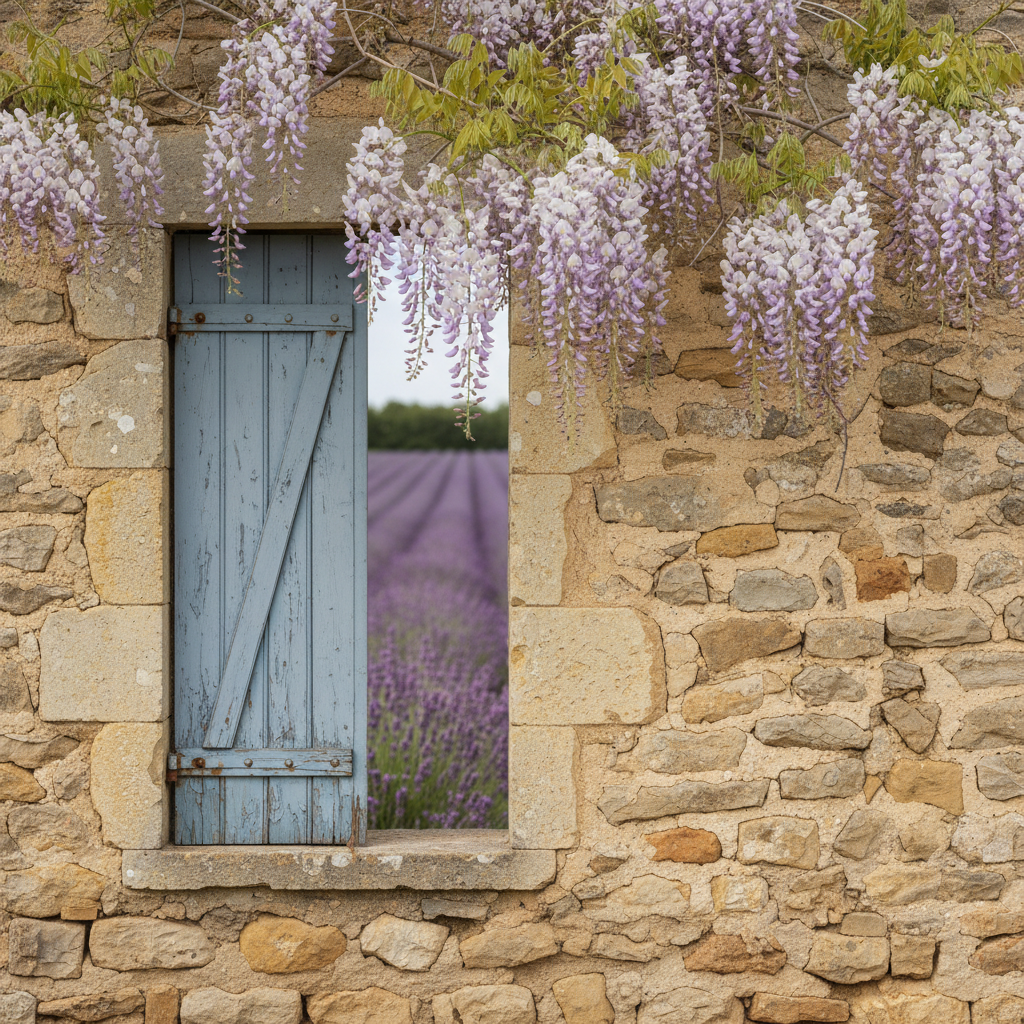
The painted shutter is a familiar emblem of the French countryside. It is a staple of postcards and travel blogs, shorthand for a certain kind of rustic charm. We see it as decoration, a splash of pleasing color—lavender blue, sage green, almond white—against a stone façade. But to view the shutter as mere ornament is to miss its purpose entirely. In Provence, it is not an accessory; it is a vital and elegant machine.
Long before the advent of mechanical air conditioning, the primary challenge of southern architecture was the management of heat and light. The sun that ripens the grapes and dries the lavender can be a punishing force. A home must be a retreat from it, a cool and shaded respite from the blaze of the midday heat. The window, left to its own devices, is a vulnerability. It is the shutter, or volet, that makes it useful.
There are two principal forms. The solid panel offers a complete blackout, a true barrier. But the more common and ingenious design is the persienne, the louvered shutter. Its angled slats are a masterclass in passive climate control. They deny entry to the direct, high-angled rays of the summer sun, yet allow air to circulate freely. The result is a cooling breeze without the searing glare.
Life in a Provençal house is modulated by the daily ritual of the shutters. They are thrown open in the cool of the morning to welcome the day, then closed just before noon as the sun reaches its zenith. The house is plunged into a dim, cool quiet. Sounds from the outside become muffled, distant. Time itself seems to slow, held in the shaded stillness of the afternoon.
To leave one’s shutters open to the midday sun is a profound cultural misstep, a sign of a visitor who has not yet learned to listen.
This daily rhythm is a conversation with the climate. It is an act of cooperation, not defiance. The materials themselves speak of this relationship. The shutters are most often made of wood, a living material that expands and contracts with the seasons. Their painted surfaces fade and peel under the persistent sun and the scouring force of the Mistral wind, recording the passage of time on their weathered faces.
An Architecture of Interiority
By closing the house off from the outside world, the shutter creates a rich and protected interiority. The dim light inside is a world away from the bright, uniform illumination we have come to expect from modern buildings. It is a light that asks for adjustment, for quiet. It is the light of the sieste, the afternoon nap that is less an indulgence than a necessity in this climate.
This stands in stark contrast to the contemporary architectural obsession with vast panes of glass. We are taught to value transparency and unbroken views, to erase the boundary between inside and out. The shutter insists on that boundary. It offers a choice, a way to mediate our relationship with the world beyond the walls. It suggests that a home is not a stage for viewing the landscape, but a sanctuary from it.
The shutter provides privacy from the gaze of neighbors, of course, but also a more profound privacy from the elements themselves. It is a shield against the sun’s interrogation. In the winter, it is an added layer of insulation against the cold and a bulwark against the ferocious Mistral, which can batter a house for days on end.
It is a simple technology, perfected over centuries, that solves a complex problem with grace. The Provençal shutter is a piece of vernacular design that speaks to a slower, more deliberate way of life, one attuned to the rhythms of the natural world. It is not about shutting life out, but about curating it, making it habitable and, ultimately, more pleasant.
Our full inquiry, with plates, studies, and a directory of the region, lives in Edition IV of our journal.
The longer reading lives in the magazine.
This essay is one observation. Edition IV carries the plates, the studies and the directory of Provence, France — thirty pages, on uncoated stock, posted across Europe.
Continue reading
All essays → Editorial · 8 min
What a house is worth, and what it costs
On the difference between price and value, and why we have stopped using the first to describe the second.
 Markets · 11 min
The quiet market
Why the most interesting European homes are no longer listed, and what that means for the people looking for them.