The Kitchen Is a Hearth, Not a Showroom
In the quiet heart of Alentejo, the kitchen rejects performance for a more profound, and functional, purpose.
The contemporary kitchen is a paradox of intention. It is designed as the focal point of the modern home, a gleaming stage set with marble islands, induction cooktops, and integrated appliances that vanish into seamless cabinetry. It is a room built for performance, yet in many homes, it is the least-used space, a showroom for a culinary life that is more aspirational than actual.
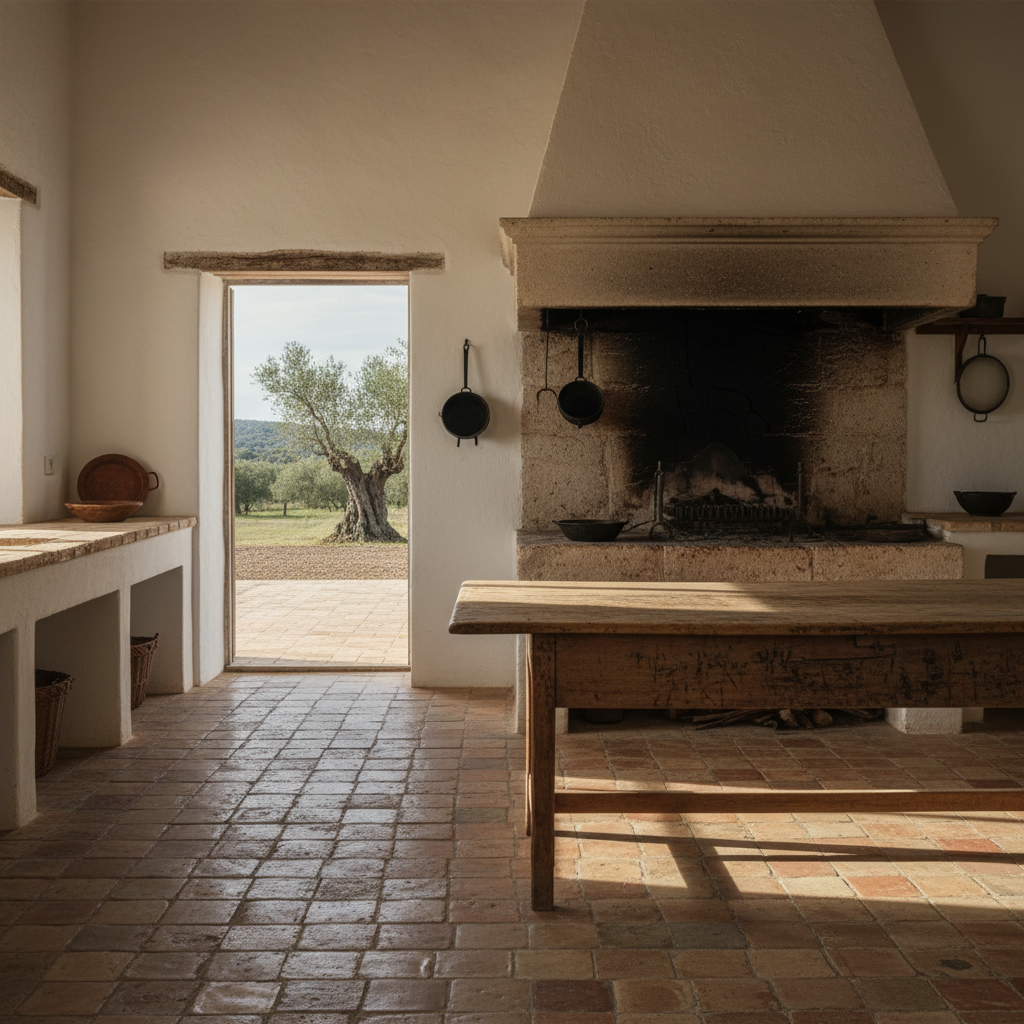
This stands in stark contrast to the kitchens found in the farmhouses, or montes, that dot the plains of Alentejo, Portugal. Here, the kitchen is rarely a showpiece. It is a room of profound utility, a space not for display but for living. It is, in the truest sense of the word, a hearth.
The Alentejo kitchen is defined by its materials and its purpose. Floors are often terracotta or stone, cool underfoot and forgiving of spills. Walls are whitewashed lime, breathable and bright. Surfaces are not precious; they are honest. A worn wooden table, a deep stone sink, and open shelves holding stacks of simple, heavy crockery are common sights.
There is no pretense of minimalism, only the evidence of use. Jars of preserves line a windowsill, a braid of garlic hangs from a hook, and a clay pot of water sits by the stove. It is a room that is always in a state of quiet, productive motion.
Here, the kitchen is not a stage for culinary performance, but a quiet, functional backdrop for life itself.
At the center of it all, literally or spiritually, is the fire. Historically, this was a large, open fireplace, the chaminé alentejana, where cooking was done over an open flame. It was the source of heat, of hot water, and of the evening meal. Its presence dictated the rhythm of the household.
A Working Heart
While modern stoves have replaced many of these open hearths, the principle remains. The kitchen is still the engine of the house, a working heart that circulates warmth and sustenance. It is a place of labor, but also of comfort. It is where bread is baked, where coffee is brewed, where conversations unfold over the task of shelling beans.
This approach is not born of a desire for rustic aesthetics. It is a natural extension of a culture that values substance, durability, and a deep connection to the land. The home is a shelter and a tool, a place to be lived in, not just looked at. The kitchen, as the most vital of its rooms, embodies this philosophy completely.
Its beauty is not in its polish but in its patina. It is a beauty that comes from wear, from daily use, from the accumulated evidence of meals shared and lives lived. It does not demand admiration; it invites participation.
To step into an Alentejo kitchen is to understand something fundamental about the Portuguese conception of home. It is a space that serves the family, not the ego. It is a quiet testament to the idea that the most beautiful things are often the most useful.
The longer reading, with plates and a directory of Alentejo, Portugal, lives in Edition I of the magazine.
The longer reading lives in the magazine.
This essay is one observation. Edition I carries the plates, the studies and the directory of Alentejo, Portugal — thirty pages, on uncoated stock, posted across Europe.
Continue reading
All essays → Editorial · 8 min
What a house is worth, and what it costs
On the difference between price and value, and why we have stopped using the first to describe the second.
 Markets · 11 min
The quiet market
Why the most interesting European homes are no longer listed, and what that means for the people looking for them.