The Line of Lavender
In the gardens of Provence, the seemingly simple arrangement of lavender offers a profound lesson in horticultural restraint.
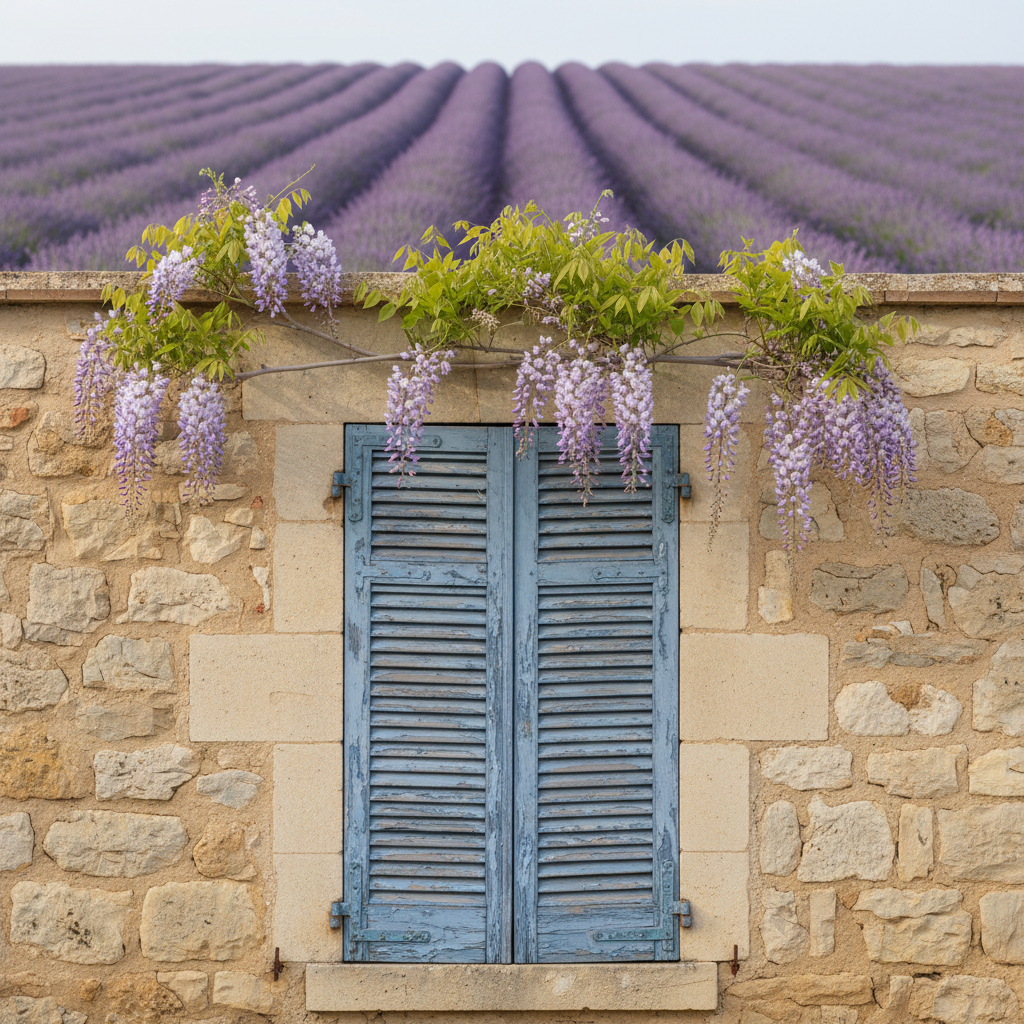
The mind’s eye holds a romantic picture of Provence. It is a place of untamed fields and rambling farmhouses. A landscape where nature is met with a light and informal touch. Yet the reality of its gardens, particularly in their use of lavender, suggests a different principle at work. Here, abundance is tempered by an almost architectural discipline. The provincial garden does not sprawl; it delineates.
One sees this most clearly in the lavender line. From the grand estates of the Luberon to the quiet courtyards of village houses, lavender is rarely left to its own devices. It is planted in decisive, geometric rows. These lines trace the edges of a stone path, define the border of a terrace, or march in uniform procession toward a view. They are less an imitation of nature and more a conversation with it.
This use of form is a quiet rebellion against the picturesque chaos often associated with country gardens. Where an English cottage garden might celebrate a riot of intermingling species, the Provençal approach isolates a single element and gives it a clear, strong voice. The repetition of the lavender plants, their silvery foliage and purple spires aligned in a singular statement, creates a rhythm. It is a steady, calming pulse in the landscape.
The line is not a cage, but a channel for expression.
There is an honesty to this method. The lavender is not asked to be anything other than itself, but it is asked to contribute to a larger, more coherent vision. This gesture, this intentionality, is what separates a mere collection of plants from a garden. It demonstrates a deep understanding of place, of light, and of the power held within a single, well-considered decision.
A Deliberate Stillness
This restraint extends beyond the lavender. It is visible in the clipped boxwood that gives a garden its winter skeleton, in the decisive placement of a single cypress tree to catch the setting sun, and in the unadorned stone walls that frame it all. Nothing is superfluous. Every element is tasked with a purpose, whether it is to provide shade, to mark a boundary, or simply to draw the eye through space.
The effect is one of extraordinary calm. The visual grammar is simple and therefore restful. By limiting the palette and insisting on structure, the gardener creates a space for contemplation. The straight line of lavender does not demand attention in the way a wild profusion of flowers might. Instead, it offers a point of focus, a place for the eye and mind to settle.
It is a difficult lesson to absorb. The temptation, in gardening as in much else, is toward more: more color, more variety, more impact. The instinct is to fill every space. Yet the lavender line teaches that subtraction can be a more powerful tool than addition. A single, perfect row of lavender against an old stone wall can possess more gravity and beauty than an entire border crowded with competing forms.
This approach is not about scarcity, but about clarity. It is an acknowledgment that a garden is a human creation, a space carved from the wildness of nature. Its success lies not in replicating that wildness, but in establishing a thoughtful dialogue with it. The disciplined form of the lavender line is the vocabulary of that dialogue.
To appreciate this is to understand something fundamental about the spirit of Provence itself. It is a region that has been shaped by centuries of sun, wind, and human effort. Its character is found in the balance between the natural and the man-made, the rugged and the refined. The lavender line is a perfect emblem of this enduring harmony.
The longer reading on the gardens of the region, with plates and a directory of Provence, France, lives in Edition IV of the magazine.
The longer reading lives in the magazine.
This essay is one observation. Edition IV carries the plates, the studies and the directory of Provence, France — thirty pages, on uncoated stock, posted across Europe.
Continue reading
All essays → Editorial · 8 min
What a house is worth, and what it costs
On the difference between price and value, and why we have stopped using the first to describe the second.
 Markets · 11 min
The quiet market
Why the most interesting European homes are no longer listed, and what that means for the people looking for them.