The Olive Before the Door
In the quiet landscapes of Alentejo, we find that the life of a home is written not in its elevation, but in the details that greet you at the threshold.
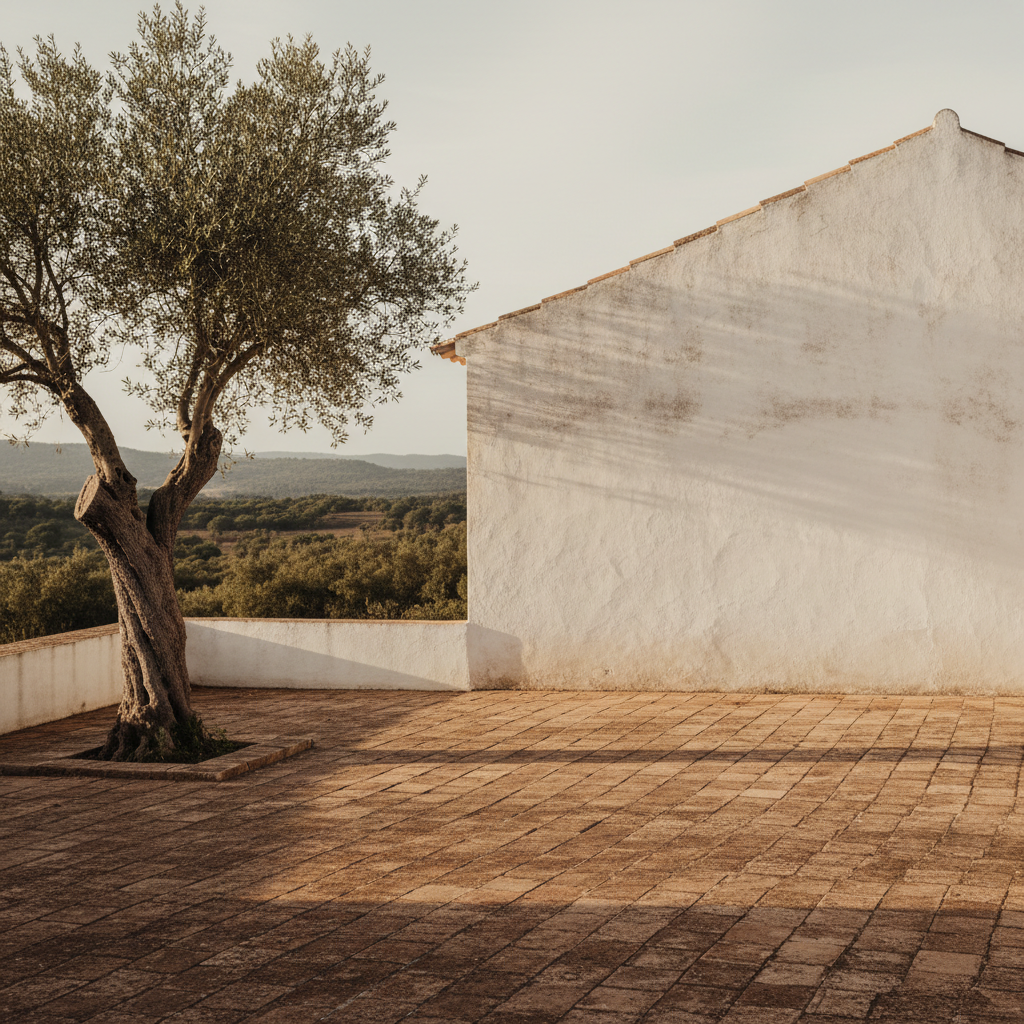
A certain quiet has settled over the plains of Alentejo. It is a quiet that emanates not from an absence of sound, but from a presence of something older and more settled. Here, the land speaks in a language of cork oaks and undulating fields, of whitewashed walls that hold the memory of the sun. It is a landscape that encourages a different way of seeing, a different way of valuing the places we inhabit.
For generations, the measure of a house was its elevation. The facade, with its careful composition of windows and doors, was a statement of intent, a public declaration of worth. We have been taught to read these elevations like a text, to find in their symmetry and proportion the story of the home and its inhabitants. We have learned to admire the grand gesture, the impressive silhouette against the sky.
Yet, in Alentejo, one is reminded that the true life of a house is often found in smaller, more intimate details. It is found in the worn texture of a stone threshold, in the particular shade of blue painted around a window frame, in the way a climbing rose has been trained to follow the line of the roof. These are the details that speak of care and attention, of a daily conversation between the house and those who live within it.
And then there is the olive tree. So often, in this part of the world, a single olive tree stands before the door. It is not a decorative flourish or a landscape architect's afterthought. It is a presence, a quiet guardian that has witnessed the comings and goings of generations. Its gnarled trunk tells a story of time, of seasons of drought and seasons of plenty.
The olive tree is the first handshake, the first welcome. It is the preamble to the story of the house.
This tree is more than a plant; it is a symbol. It speaks of a connection to the land, of a desire for sustenance and continuity. It offers shade in the heat of summer and its fruit in the coolness of autumn. It is a reminder that a home is not just a shelter, but a place of cultivation, of nurturing and being nurtured.
The Grammar of a Home
To focus on the olive tree is to shift our understanding of what makes a house a home. It is to move away from the language of grand architectural statements and towards a more intimate grammar of domestic life. It is to recognize that the quality of a home is not measured in square meters or ceiling heights, but in the moments of quiet beauty it affords, in the small rituals it encourages.
A house need not be a masterpiece of design to be a place of profound meaning. It must simply be a place where life can unfold in all its simple, unadorned richness. The olive tree before the door does not announce itself with fanfare. It simply stands, a quiet testament to a life lived in harmony with the land, a life that values the simple gift of a single tree.
It is a lesson in humility, a reminder that the most profound experiences are often the most unassuming. It is a way of building and living that we are slowly, and thankfully, rediscovering. It is a return to a more human scale, a more sustainable way of being in the world.
The longer reading, with plates and a directory of Alentejo, Portugal, lives in Edition I of the magazine.
The longer reading lives in the magazine.
This essay is one observation. Edition I carries the plates, the studies and the directory of Alentejo, Portugal — thirty pages, on uncoated stock, posted across Europe.
Continue reading
All essays → Editorial · 8 min
What a house is worth, and what it costs
On the difference between price and value, and why we have stopped using the first to describe the second.
 Markets · 11 min
The quiet market
Why the most interesting European homes are no longer listed, and what that means for the people looking for them.