The Olive Tree Before the Door
The small details that ground a home in its landscape matter more than any grand architectural gesture.
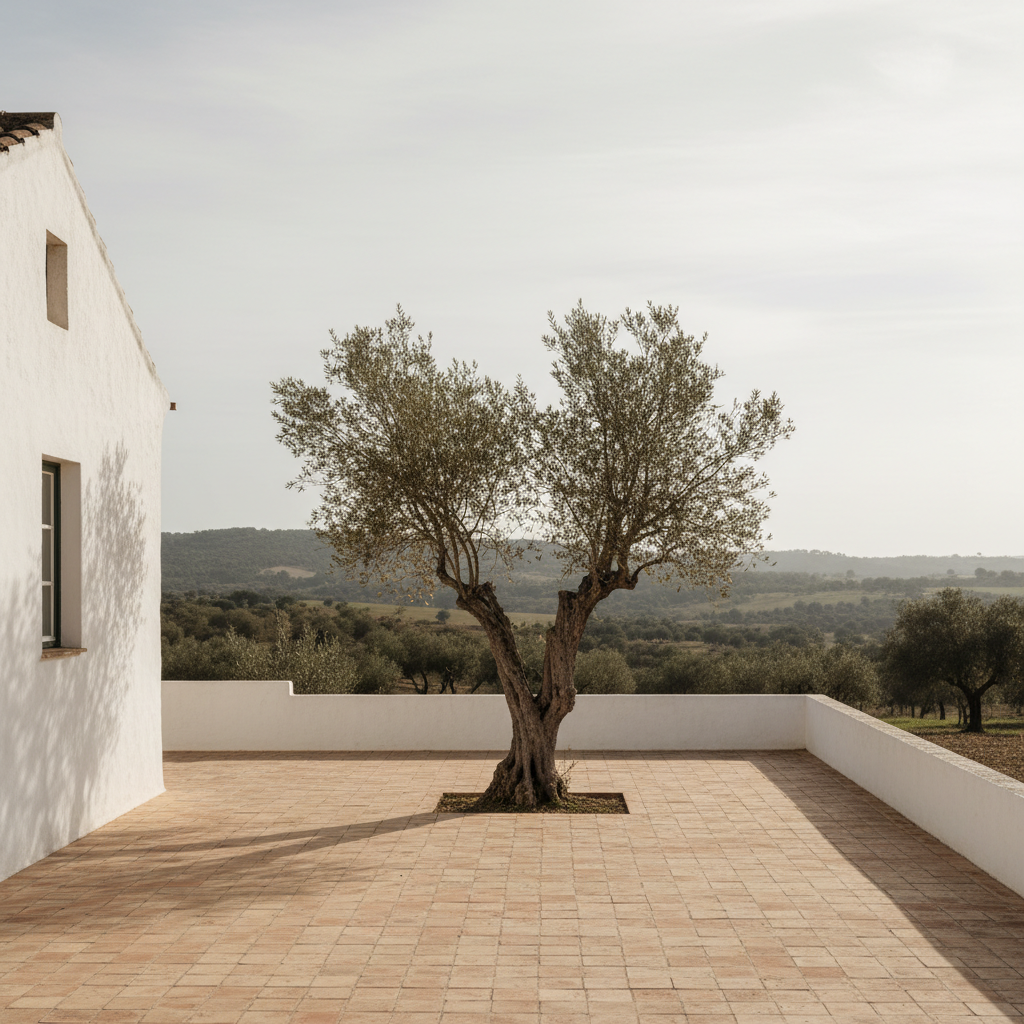
A house is more than its elevation. In architecture, that term refers to a flat, two-dimensional drawing of a facade, a view from one side. It is a study of shape, proportion, and material, but it is lifeless. It communicates a plan, but not a feeling. It speaks to the intellect, but not to the soul that will one day inhabit the space.
We have come to prefer the living dimension. The way light falls across a wall, the texture of a floor underfoot, the sound of a door closing. These are the details that transform a structure into a home. They are the elements that cannot be captured in a simple drawing, yet they are the moments that define our experience within a space.
Consider the olive tree. In the sun-drenched plains of Alentejo, Portugal, it is not uncommon to find a single, ancient olive tree standing sentinel before the entrance to a whitewashed farmhouse. It is rarely a formal choice, more a happy accident of preservation. The house was built to accommodate the tree, not the other way around. This simple act of deference speaks volumes.
The tree offers shade in the summer and a sense of permanence in the winter. Its gnarled trunk is a record of time, a connection to the generations who have passed through the same doorway. It provides a focal point, a natural sculpture that changes with the seasons. It is, in its own quiet way, the most important feature of the home.
The house was built to accommodate the tree, not the other way around.
This is not a new idea, but it is one we seem to have forgotten in our pursuit of novelty and scale. We are often so concerned with the grand statement of a building’s facade that we neglect the small, humble details that give it life. We design for the photograph, the portfolio, the elevation view, and in doing so, we create spaces that are impressive but not necessarily inviting.
The Measure of a Home
A home’s true character is revealed in its relationship to the world around it. Does it work with the landscape, or does it impose itself upon it? Does it honor the history of its place, or does it seek to erase it? These are the questions that interest us.
The olive tree is a symbol of this deeper connection. It represents a way of thinking about design that prioritizes harmony over spectacle, and intimacy over impact. It suggests that the most meaningful architectural choices are often the ones that are the most subtle, the ones that are born of respect for the existing environment.
To choose to keep the tree is to choose a different set of values. It is to say that the dappled light it casts on the wall is more important than a perfectly symmetrical facade. It is to acknowledge that the history held within its rings is a more powerful story than any an architect could write.
This quiet deference shapes the entire experience of the home. It is a constant, gentle reminder of a world outside the walls, a world of sun and soil and slow, patient growth. It makes the act of coming home a return not just to a building, but to a place.
The longer-form exploration of this idea, with plates and a directory of Alentejo, Portugal, is available in the first edition of our journal.
The longer reading lives in the magazine.
This essay is one observation. Edition I carries the plates, the studies and the directory of Alentejo, Portugal — thirty pages, on uncoated stock, posted across Europe.
Continue reading
All essays → Editorial · 8 min
What a house is worth, and what it costs
On the difference between price and value, and why we have stopped using the first to describe the second.
 Markets · 11 min
The quiet market
Why the most interesting European homes are no longer listed, and what that means for the people looking for them.