The Private Cathedral of Southern Spain
The precedent for the Andalusian home is not a castle or a villa, but the serene, shaded interior of Córdoba’s great mosque.
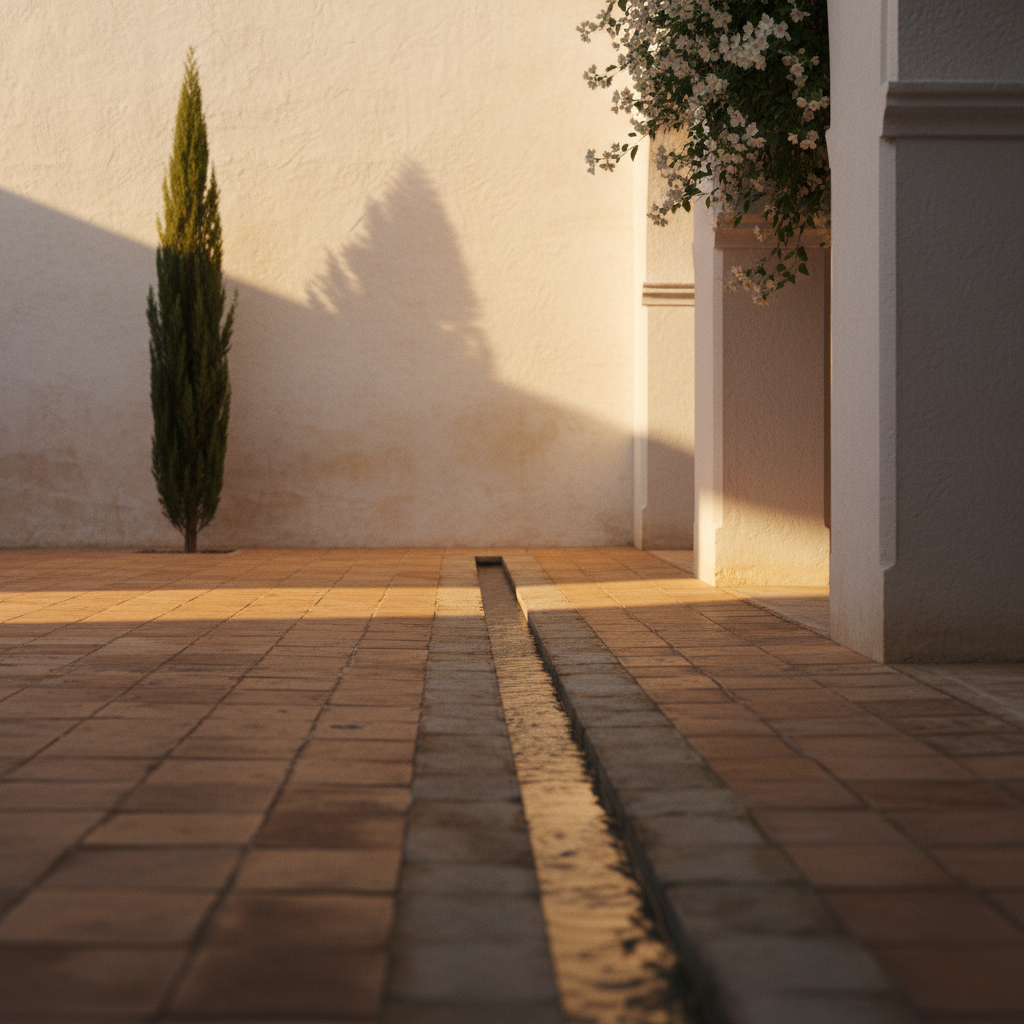
To walk through the old quarters of Córdoba or Seville is to witness a quiet conversation. It is a dialogue between the public street and the private interior, mediated by gates of iron and walls of plaster. What lies behind those walls is a tradition of domestic space shaped not by palaces or country villas, but by a profound work of sacred architecture: the Mezquita-Catedral of Córdoba.
Begun in the 8th century, the Great Mosque of Córdoba was a departure from the soaring, light-filled cathedrals of Christian Europe. Its builders created an inward-facing world. Inside, a seemingly infinite forest of columns and candy-striped arches creates a space that is dense yet permeable, enclosed yet boundless. The eye is not drawn upward to a single celestial point, but horizontally, through a tranquil and repeating landscape.
The experience is one of managed light. Rather than being flooded with sun, the interior is cooled by a kind of architectural twilight. The air is still. Sound is muffled by the sheer mass of stone and the endless rhythm of the columns. It is a space designed for introspection and quiet contemplation, a sanctuary from the relentless sun of southern Spain.
In the Andalusian home, the courtyard functions as an open-air mosque—a place of quietude, shade, and measured light.
This model of a serene, enclosed world found its secular expression in the domestic architecture of Andalusía. The house turns its back on the street, presenting a simple, often austere facade. Its treasures are held within. Once you pass through the 'zaguán,' a small vestibule, you do not enter a hallway or a formal receiving room, but an open-air courtyard—the patio.
The patio is the heart of the home, a direct descendant of the mosque’s own 'Patio de los Naranjos.' It is a private sky, a captured piece of the outdoors brought inside the domestic sphere. Here, the architectural grammar of the mosque is repurposed for family life.
The Grammar of Shade
The columns of the mosque become the arcades of the patio. The play of light and shadow, once a tool for sacred mystery, is now a mechanism for climate control. The courtyard creates a microclimate, drawing cool air down while the surrounding rooms offer deep shade. Ceramic tiles, often in geometric patterns that echo Islamic art, cover the floors and walls, their glazed surfaces cool to the touch.
Water, central to the ablutions of the mosque, becomes the focal point of the patio. A small fountain or a simple channel of water—a 'rill'—murmurs at the center. The sound cools the air and calms the mind, masking the noise of the city. It is the same principle of sensory withdrawal and focused tranquility found within the walls of the Mezquita.
The home became a miniature cosmos, organized around the same principles of shade, water, and seclusion. Each room opens onto the central court, blurring the line between inside and out. Life is lived not in sealed boxes, but in a fluid relationship with this captured bit of nature.
This architectural language speaks to a different understanding of luxury. It is not about grand facades or outward displays of wealth. It is the luxury of coolness in a hot climate, of silence in a dense city, of privacy, and of a deep, abiding connection to a specific sense of place.
The influence is subtle, woven into the very fabric of daily life. It is there in the hush of a summer afternoon, the scent of jasmine climbing a plaster wall, and the simple comfort of deep shade. The house is not merely a shelter, but a private cathedral for living.
The longer reading lives in the magazine.
This essay is one observation. Edition II carries the plates, the studies and the directory of Andalusía, Spain — thirty pages, on uncoated stock, posted across Europe.
Continue reading
All essays → Editorial · 8 min
What a house is worth, and what it costs
On the difference between price and value, and why we have stopped using the first to describe the second.
 Markets · 11 min
The quiet market
Why the most interesting European homes are no longer listed, and what that means for the people looking for them.