The Quiet Grammar of Tuscan Iron
In the quiet landscapes of Tuscany, the smallest iron details on a stone facade reveal the story of its keeping.
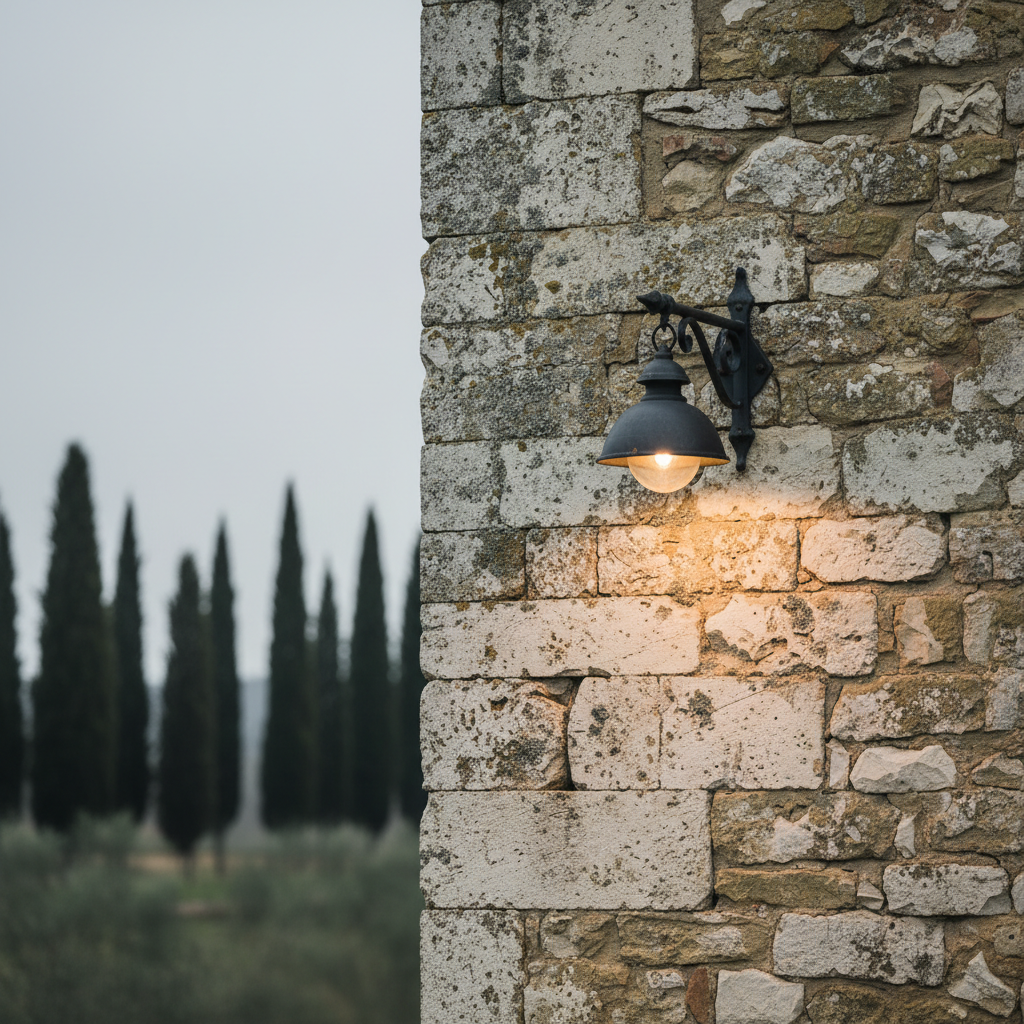
The first impression of a Tuscan farmhouse is of monolithic permanence. Stone, drawn from the earth it sits upon, is stacked in a patient geology of its own. These houses feel less constructed and more revealed, as if the surrounding landscape had been scraped away to show the dwelling within. They are affirmations of weight and time, settled into the folds of the Val d’Orcia or the Chianti hills with a sense of inevitability.
One learns to read the story of these structures not just in their scale, but in their smaller articulations. The eye adjusts, moving past the immensity of the stone to the punctuation marks that hold it in place. Here, a different material asserts itself: iron. Black, definite, and forged with intention.
It appears as the hinge-pins, or *cardini*, on which heavy wooden shutters pivot. It is in the simple, forged handles for those same shutters, worn smooth by generations of hands. On grander buildings, it manifests as the ornate window grills, or *inferriate*, whose intricate scrolls offer a delicate counterpoint to the mass of the wall behind them. These are not mere decorations.
The most critical pieces are often the most overlooked. Look closely at a broad, ancient facade and you may see a series of small, dark metal plates. These are the ends of tie-rods, or *chiavi*, which run through the building to brace the stone walls, anchoring them against the slow, outward push of gravity and time. They are the stitches holding the whole garment together.
It is the quiet dialogue between yielding iron and unyielding stone.
A house in Tuscany is not simply old; it is either kept or it is not. The state of its iron is the clearest indicator. Where the metal is rusted through, where a grill is bent or a tie-rod plate is missing, one feels the presence of decay. The structure is slowly being surrendered to the elements. The patience of the stone is turning towards ruin.
The Logic of Iron
Where the iron is whole, however, painted a severe, functional black, the house feels alive. It tells a story of maintenance, of small, consistent acts of care. Someone chose to scrape away the rust. Someone tightened the bolt. Someone ensured the lantern by the door, a simple iron cage for a bulb, was still sound.
This metalwork speaks to a logic of preservation. Stone endures, but it is passive. Iron intervenes. It is the active principle, the human decision to reinforce and to hold fast. It does not pretend to the permanence of stone, but its presence is a commitment to the continued life of the structure. It is a humble but essential grammar.
The quality of a place is not always in its grand, sweeping gestures. It is often in the details that are small enough to be done well. The turn of a scroll, the seating of a rivet, the simple black line of a tie-rod against a field of grey stone—these are the marks of a home that is truly possessed by its inhabitants.
The longer reading, which considers the enduring character of this landscape and its architecture, is available in Edition III of the journal.
The longer reading lives in the magazine.
This essay is one observation. Edition III carries the plates, the studies and the directory of Tuscany, Italy — thirty pages, on uncoated stock, posted across Europe.
Continue reading
All essays → Editorial · 8 min
What a house is worth, and what it costs
On the difference between price and value, and why we have stopped using the first to describe the second.
 Markets · 11 min
The quiet market
Why the most interesting European homes are no longer listed, and what that means for the people looking for them.