The Quiet Journey of Alentejo Stone
From a dusty quarry in the Portuguese countryside, a single block of marble begins a silent journey to the city.
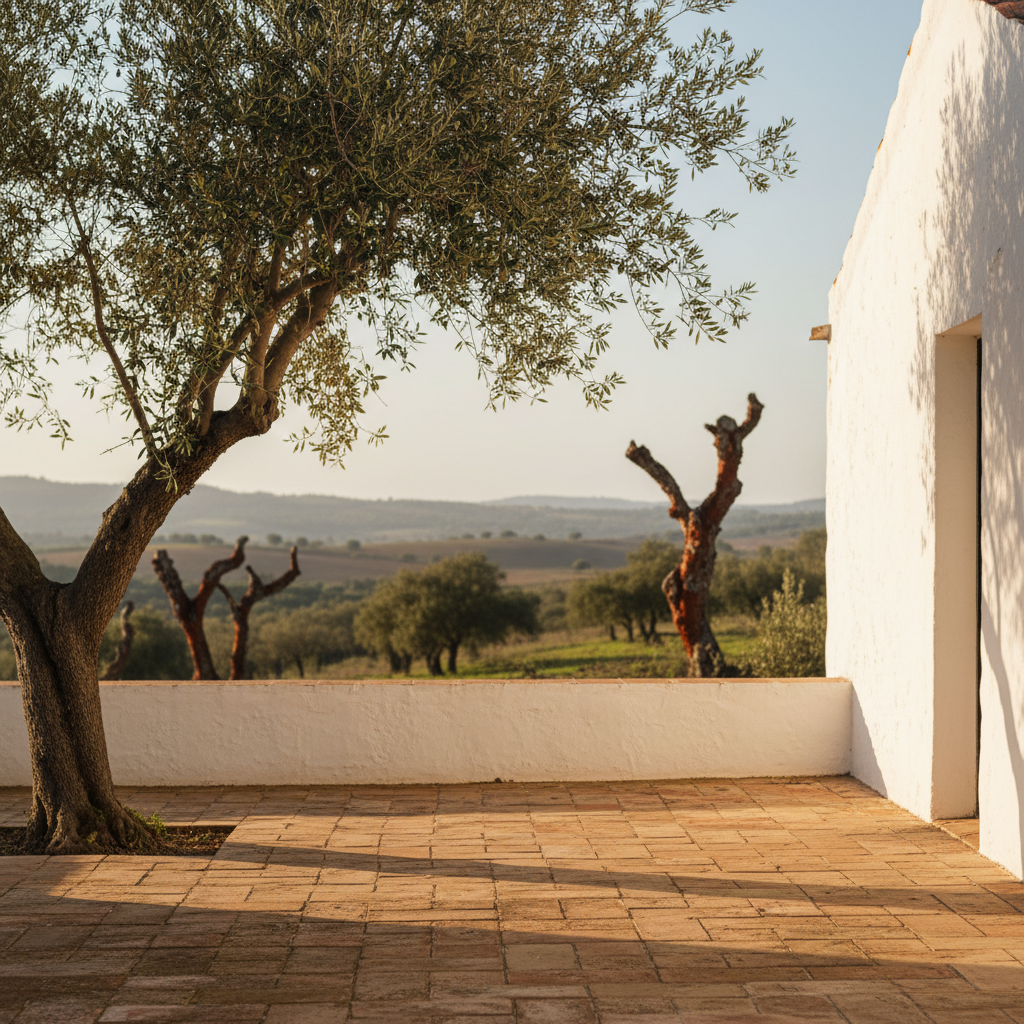
The roads that cross the Alentejo are long and quiet. They rise and fall with the undulations of the plains, past cork forests, olive groves, and whitewashed farmsteads that hold their place under a vast sky. This is a landscape of patience, of slow growth and geological time. And deep beneath the red soil lies another of its quiet treasures: a substratum of marble, veined with pink and cream.
Near the towns of Estremoz, Borba, and Vila Viçosa, the earth is opened to reveal this stone. These are not vast, industrial operations, but often family-run quarries that have been worked for generations. The air hums with a steady industry, but it does not overwhelm the calm of the surrounding countryside. Here, colossal blocks are carefully coaxed from the bedrock, each one a unique record of the pressures and minerals that formed it centuries ago.
The process of extraction is one of both power and precision. Diamond-wire saws score deep lines into the quarry face, defining the dimensions of the block. There is a moment of profound tension, and then a clean break. A rough-hewn cuboid, weighing many tons, is lifted from the place it has occupied for millennia. It rests on the quarry floor, covered in a fine white dust, awaiting the first leg of its journey.
That journey is often a short one, on the flatbed of a truck that trundles along a dirt track to a nearby workshop. These *serrações* are unassuming buildings, their yards filled with raw blocks in various states of transformation. Inside, the noise is sharp and constant, a stark contrast to the silence of the plains. This is where the stone begins its conversation with the craftsman.
From Block to Slab
The air inside the workshop is cool and damp, thick with the mineral scent of cut stone. A film of white dust covers every surface. Water slicks the concrete floor, used to cool the immense saws that slice the blocks. Here, a different kind of knowledge is required—not of geology, but of geometry and potential. The stonecutter must read the faint lines on the block’s rough surface, intuiting the patterns that lie within.
An operator guides the multi-bladed gang saw, and with a high-pitched whine, the machine begins its slow descent. It can take a full day to cut a single block into a series of slabs, each one two or three centimeters thick. The stone does not hurry. It holds the memory of deep geologic time, and it demands a similar patience from those who work it.
The stone does not hurry. It holds the memory of deep geologic time, and it demands a similar patience from those who work it.
Once cut, the slabs are laid out, and their surfaces are ground and polished in successive stages. What was chalky and rough becomes smooth, then lustrous. The true colors emerge: the soft rose, the creamy white, the subtle grey tracery. The polishing reveals the stone’s character, turning it from a piece of raw geology into a surface, a plane for living.
The finished slab is then catalogued. Its edges are marked with a code that identifies its block of origin, its dimensions, its provenance. It is now a commodity, ready for architects and designers. It leans in a long row with its fellows, a library of silent, heavy pages, each telling the same story of pressure and time in a slightly different way.
From the quiet of the Alentejo, the slab travels to the city. It may arrive at a design studio in Lisbon, where it is selected for a specific project—a kitchen counter, a bathroom vanity, the floor of a sunlit hall. The journey is a study in contrasts: from the open, elemental landscape to the dense, constructed fabric of the metropolis.
Finally, it reaches its resting place. Cut to size and installed by another set of craftsmen, the marble finds its home. In a restored apartment in Príncipe Real, the same stone that was pulled from a sun-baked hill now cools the touch of a hand reaching for a glass of water. It becomes the backdrop for the small, domestic rituals of daily life, carrying the immense quiet of its origins into the heart of the city.
The longer reading lives in the magazine.
This essay is one observation. Edition I carries the plates, the studies and the directory of Alentejo, Portugal — thirty pages, on uncoated stock, posted across Europe.
Continue reading
All essays → Editorial · 8 min
What a house is worth, and what it costs
On the difference between price and value, and why we have stopped using the first to describe the second.
 Markets · 11 min
The quiet market
Why the most interesting European homes are no longer listed, and what that means for the people looking for them.