The Quiet Work of a Wall
In the sun-scorched plains of Alentejo, Portugal, the whitewashed walls of a house do more than just stand.
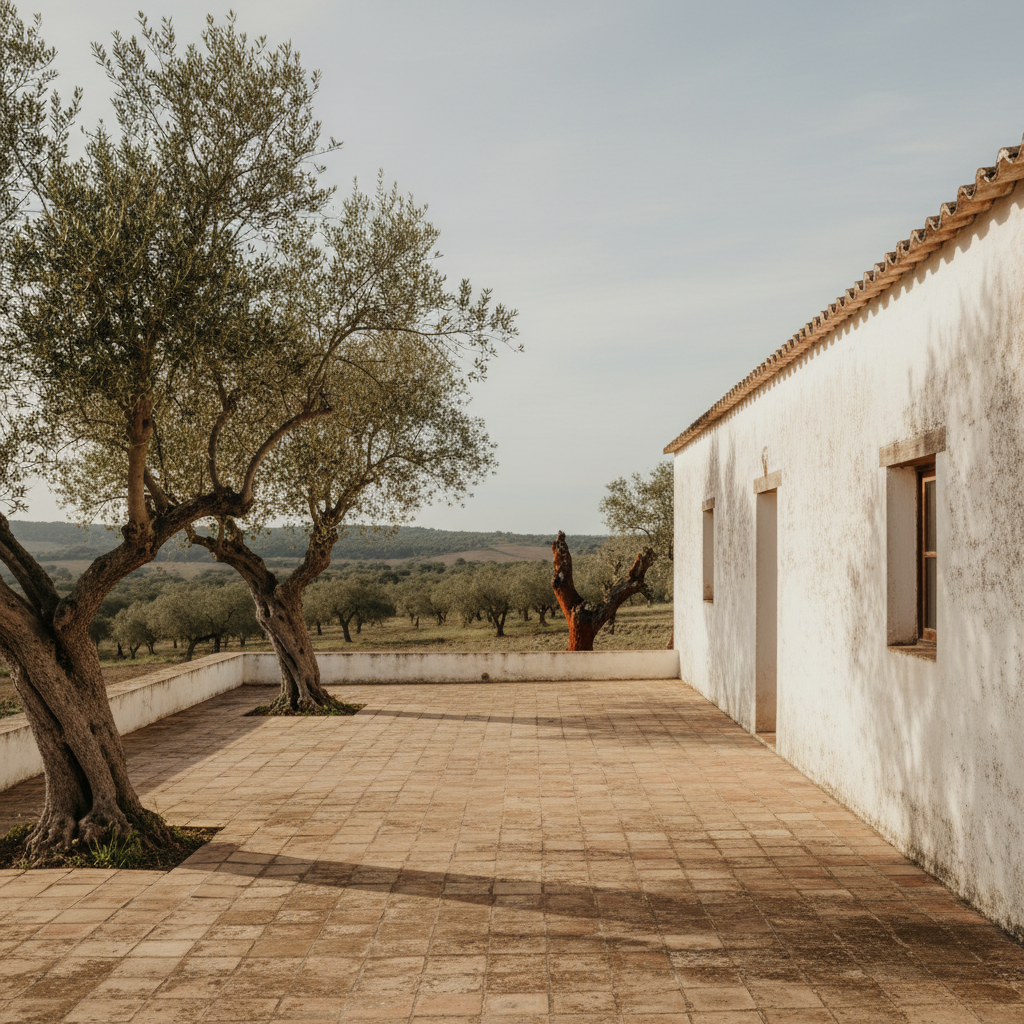
To drive through the Alentejo is to witness a landscape of repetition. Cork oaks, olive groves, and the low, whitewashed silhouette of a farmhouse, or monte, sitting alone on a hill. These houses are a defining feature of the region, their brilliant white a stark and beautiful contrast to the golden plains and deep blue sky. They appear as simple structures, built to withstand the elements.
The whiteness is not the result of modern synthetic paint. It is cal, or lime wash, a traditional coating made from limestone that has been heated and mixed with water. This is a finish that has been used for centuries across the Mediterranean, and in Alentejo, it is fundamental to the character and function of the architecture. It is a material of the earth.
The most immediate purpose of the white surface is to reflect the sun. In a region where summer temperatures can be punishingly high, a reflective exterior is not an aesthetic choice but a necessary strategy for survival. The lime coat acts as a shield, deflecting solar radiation and helping to keep the interior cool.
Yet, the true intelligence of these walls lies in a more subtle, dynamic quality. The lime wash allows the structure to breathe. It is a porous membrane, mediating the relationship between the interior climate and the world outside. This is a house that responds to the seasons.
The wall is not an inert barrier but a participant in the life of the house.
Unlike cement-based renders or acrylic paints, which form a sealed, impermeable layer, lime wash has a high degree of vapor permeability. It absorbs and releases moisture. This capacity transforms the thick stone or rammed-earth walls of a monte into a climate-regulating system, working silently throughout the year.
The House in Dialogue
During the mild, wetter winters, the walls absorb excess humidity from the air inside the home. This helps to prevent the damp, chilling feeling that can permeate old stone houses, creating a more comfortable and stable indoor atmosphere without mechanical intervention. The house holds the moisture of the damp months in its very structure.
Then, as the seasons turn and the dry, intense heat of summer arrives, the walls slowly release this stored moisture back into the interior. Through a process of natural evaporation, they perform a kind of passive air conditioning. The effect is subtle, a quiet exhalation that gently lowers the temperature within the home.
A lime-washed wall is never uniform or static. It develops a patina over time, marked by rain and sun, and its texture and slight variations in tone give it a living quality. The finish is not meant to be flawless; its imperfections are part of its integrity.
The application of the lime wash is a cyclical act. Traditionally, houses would be re-coated each spring, a ritual of renewal that prepares the home for the coming year. This annual maintenance is a conversation between the inhabitant and the dwelling.
To understand a house in Alentejo is to understand its skin. The whitewashed wall is more than a decorative choice; it is a piece of vernacular technology, perfectly suited to its place. It is a quiet, responsive system that makes a home more comfortable, more efficient, and more deeply connected to the land on which it sits.
The longer reading lives in the magazine.
This essay is one observation. Edition I carries the plates, the studies and the directory of Alentejo, Portugal — thirty pages, on uncoated stock, posted across Europe.
Continue reading
All essays → Editorial · 8 min
What a house is worth, and what it costs
On the difference between price and value, and why we have stopped using the first to describe the second.
 Markets · 11 min
The quiet market
Why the most interesting European homes are no longer listed, and what that means for the people looking for them.