The Quiet Work of Alentejo Marble
From a dusty quarry in Portugal’s interior, a block of stone is cut and shaped for a Lisbon kitchen.
The kitchen counter is cool to the touch. In the morning light of a Lisbon apartment, its surface is a landscape of grey veins on a field of pale rose. It is a simple, functional object, yet it holds a story of geology, industry, and craft that begins miles away, under a different sun.
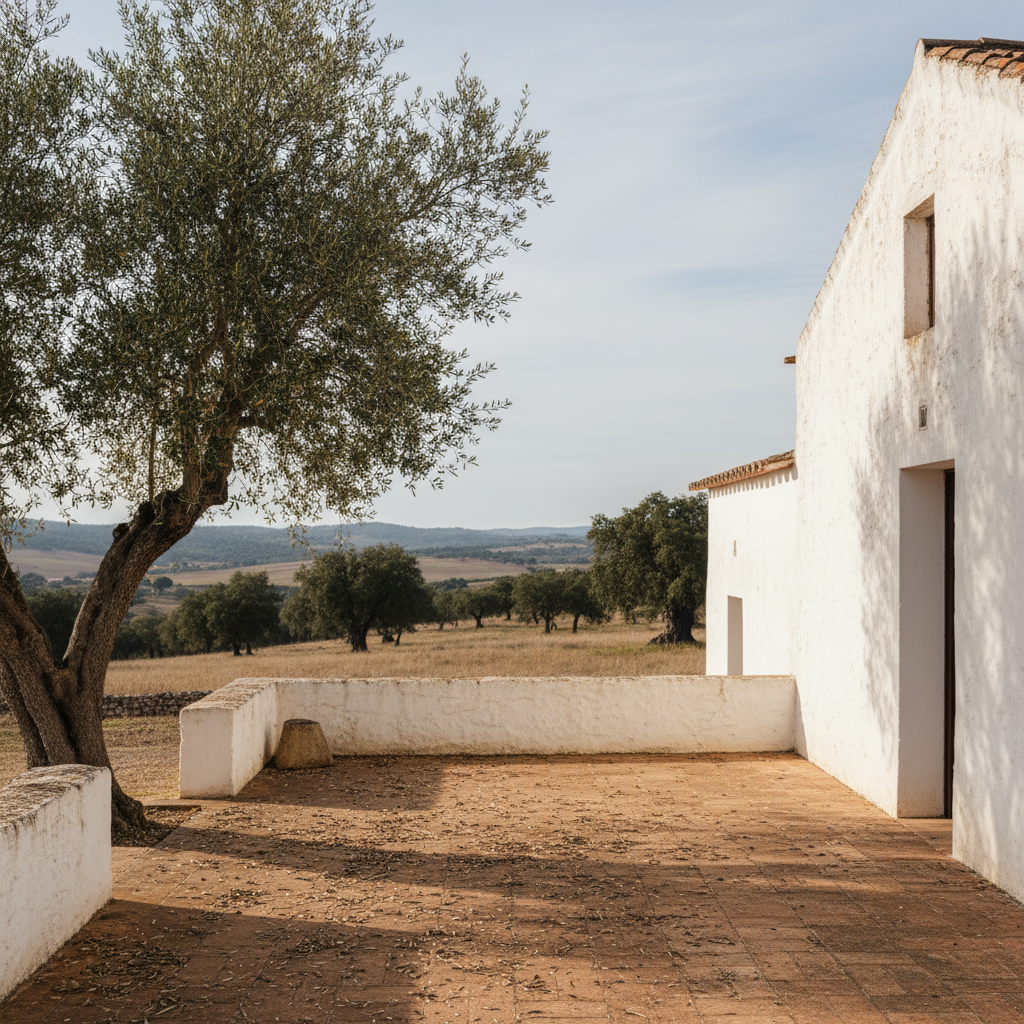
That story belongs to Alentejo. The region is known for its rolling plains, its cork forests, and its profound sense of quiet. But between the olive groves and whitewashed villages lies another of its identities: a land of stone. The Estremoz anticline, a geological formation rich in marble, has been quarried since Roman times. The towns of Estremoz, Borba, and Vila Viçosa form a triangle of extraction and processing.
The quarries themselves are stark and monumental. They are inverted cathedrals, dug deep into the earth, with sheer white walls that descend in geometric terraces. The scale is immense, and the air is thick with a fine white dust that coats everything. Here, enormous blocks, weighing many tons, are cut from the earth with diamond wires.
These raw, hulking masses are the starting point. They are geological artifacts, holding the compressed history of ancient seabeds. Their potential is hidden within, and it is the work of smaller, local workshops to reveal it.
From Block to Slab
Away from the grand scale of the quarry, the work becomes more intimate. In unassuming warehouses on the outskirts of town, family-run workshops take delivery of the blocks. The sound of high-speed saws cutting through stone is a constant, buffered by the steady flow of water that keeps the blades from overheating. It is a loud, wet, and methodical process.
A block of stone is a book. The saw is the reader.
Here, the blocks are sliced into slabs, each one a page revealing a unique pattern. The decisions made by the operator—the angle of the cut, the thickness of the slab—determine the character of the final product. It is a craft of straight lines and careful measurements, a dialogue between the sawyer and the stone. There is an inherited knowledge in this work, a sense of how the stone will behave, where its tensions lie, and how its patterns will emerge.
Once cut, the slabs are polished. What was a rough, chalky surface becomes luminous and smooth. The process refines the material, transforming it from a piece of raw geology into an architectural element. The water rinses away the dust, and the true color and depth of the marble are finally seen.
The finished slabs are stacked in the yard, a library of stone waiting for selection. Architects and designers come to choose the material for a city project, a hotel lobby, or a private residence. They look for a certain color, a specific pattern of veining, a character that suits their design.
A slab of Rosa Portugal is chosen. It is loaded onto a truck and makes the journey west, leaving the dry plains of Alentejo for the coast. It travels the same roads as the region’s wine and olive oil, another raw material bound for the capital.
Installed in the Lisbon kitchen, the marble’s long, quiet history is complete. It has been moved from the earth, cut, shaped, and polished, its final form a testament to the land from which it came and the hands that worked it. It becomes a silent part of a home.
The longer reading lives in the magazine.
This essay is one observation. Edition I carries the plates, the studies and the directory of Alentejo, Portugal — thirty pages, on uncoated stock, posted across Europe.
Continue reading
All essays → Editorial · 8 min
What a house is worth, and what it costs
On the difference between price and value, and why we have stopped using the first to describe the second.
 Markets · 11 min
The quiet market
Why the most interesting European homes are no longer listed, and what that means for the people looking for them.