The Quiet Work of Still Water
In the Andalusian courtyard, the most effective cooling comes not from the splash of a fountain but from stillness.
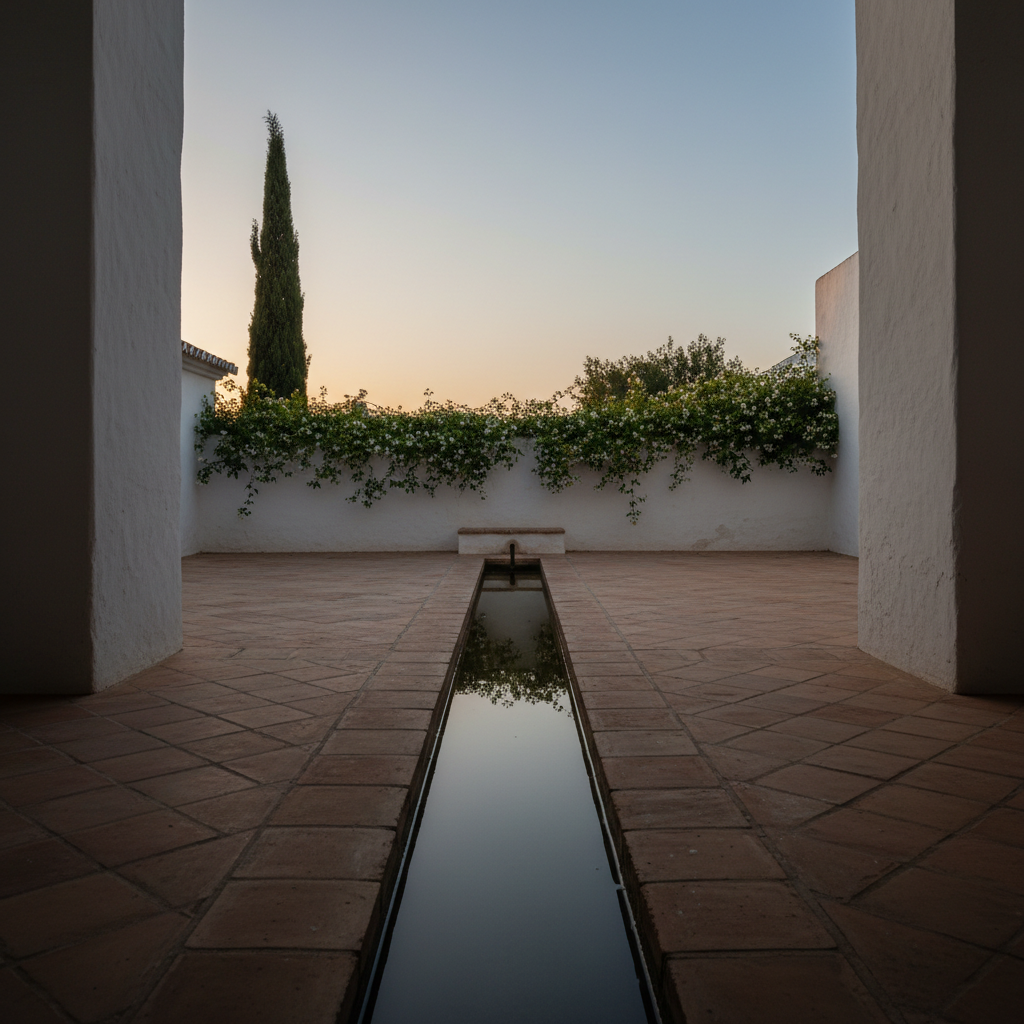
The sound of water is a promise in a hot climate. In the courtyards of southern Spain, where the sun holds dominion for much of the year, the fountain is a celebrated feature. Its splash and dance are an intuitive signal of relief, a performance of coolness that delights the senses. We hear the water, see its arc against the hot air, and feel its mist. It feels, instinctively, like the answer to the heat.
We have come to equate the fountain’s energy with its effect. The more dramatic the splash, the more water is in motion, and therefore, the more cooling it must provide. This is the assumption that governs so many modern water features, which prioritize the theater of moving water over the quiet physics of temperature exchange.
Yet the traditional Andalusian patio often relies on a far more subtle instrument. It is a feature so understated it can go unnoticed: the rill, a shallow channel of still or slow-moving water. It makes no sound. It offers no performance. It simply holds water, reflecting the sky and the surrounding architecture.
This quiet presence is deceptive. The rill is not a merely decorative element, a precursor to the more “advanced” fountain. It is, in fact, a more sophisticated and effective tool for cooling the air. Its power lies not in motion, but in its strategic stillness.
The fountain speaks of water, but the rill does its work.
The Physics of Stillness
The primary mechanism by which water cools air is evaporation. For water to change state from liquid to gas, it must draw energy from its surroundings, and it takes that energy in the form of heat. As water evaporates from a surface, it actively pulls warmth from the air directly above it, lowering the ambient temperature. The goal, then, is to maximize evaporation.
The fountain, for all its drama, is surprisingly inefficient at this task. Its cooling effect is localized. Droplets of water are thrown into the air, but they have a relatively small surface area for their volume and are airborne for only a moment before falling back into the basin. The primary sensation of coolness comes from the direct contact of mist on skin, not from a significant change in the courtyard’s overall climate.
The rill, by contrast, is a master of passive efficiency. By spreading water in a thin, wide sheet, it creates a vast surface area with minimal volume. This large, uninterrupted surface is in constant contact with the hot, dry air of the courtyard. The stillness of the water gives the process time.
All day long, without a single sound, the water in the rill steadily evaporates, constantly drawing heat out of the atmosphere. It is a slow, silent, and profoundly effective transaction. The coolness it generates is not a momentary splash but a settled, ambient condition—a genuine lowering of the temperature in the shaded sanctuary of the patio.
This preference for the rill over the fountain reveals a certain wisdom. It is a design born from observation, one that favors quiet efficacy over loud display. It understands that the deepest comforts are often the most subtle and that true relief from the heat is not a performance, but a change in the air itself. The courtyard is a space for peace, and the silence of the rill is an integral part of its tranquility.
Our extended study of the Andalusian courtyard, complete with architectural plates and a directory to the region, is available in Edition II of the journal.
The longer reading lives in the magazine.
This essay is one observation. Edition II carries the plates, the studies and the directory of Andalusía, Spain — thirty pages, on uncoated stock, posted across Europe.
Continue reading
All essays → Editorial · 8 min
What a house is worth, and what it costs
On the difference between price and value, and why we have stopped using the first to describe the second.
 Markets · 11 min
The quiet market
Why the most interesting European homes are no longer listed, and what that means for the people looking for them.