The Quiet Work of Still Water
In the Andalusian courtyard, the most effective cooling comes not from the spray of a fountain, but from the unmoving surface of a rill.
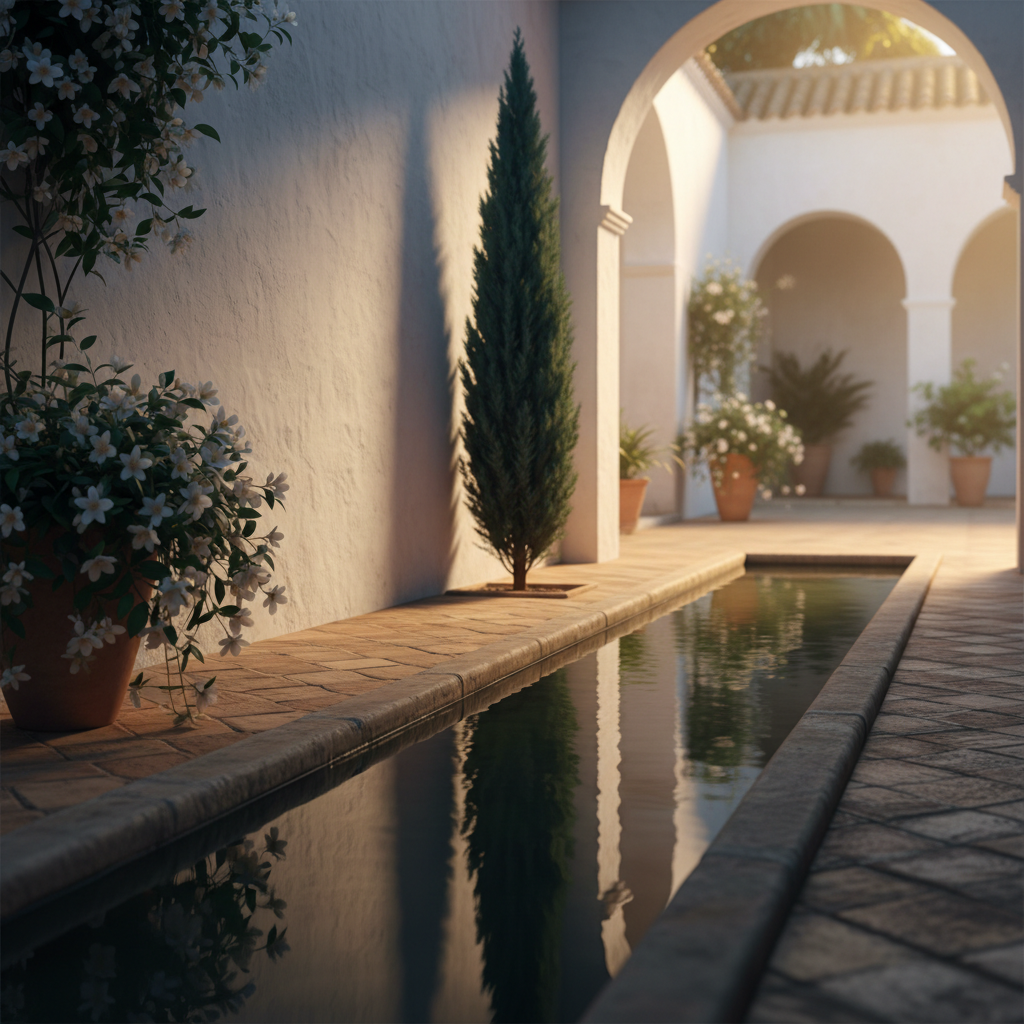
The sun in the south of Spain carries a weight that is almost geologic. In the long hours of the afternoon, it presses down, silencing streets and driving life indoors. For centuries, the architecture of the region has offered a response not of opposition, but of intelligent retreat. The answer to the heat is the courtyard, a shaded, private world carved from the home.
At the heart of this world lies water. We associate the courtyards of Granada and Córdoba with the sound of fountains, with the splash and scatter of droplets catching the light. The fountain seems a natural engine of cool, its energetic display a visible assault on the stillness of the heat. It is an intuitive connection: moving water, moving air, a general sense of refreshment.
This intuition, however, is mistaken. The cooling effect of water in a dry climate is not a matter of theatre, but of physics. The process is evaporation. As water transitions from liquid to gas, it draws energy—in the form of heat—from the surrounding air. The more water that can evaporate, the more the air will cool.
Consider the fountain. It atomizes water, creating a fine mist. While these small droplets have a large surface area collectively, they are also liable to be carried away by the slightest breeze, and the cooling effect is often localized and fleeting. The sound, while pleasant, is merely a byproduct of hydraulic energy, not a measure of thermal efficiency.
The genius of the rill is its expansive, unbroken surface, a quiet mirror offered up to the dry air.
The alternative is the rill, or *alberca*—a shallow, motionless channel or pool of water. Its power lies in its stillness. A wide, still surface of water provides a constant, maximized area for evaporation. The cooling is not dramatic, but it is pervasive and deep. The air that spills over the lip of the rill and into the courtyard is consistently cooler, denser, and heavier, sinking to the floor and displacing the warmer air above.
The Physics of Stillness
This is the quiet work of a large surface area. Unlike the chaotic spray of a fountain, whose cooling potential is subject to wind and momentary dispersion, the rill is a stable system. It is a patient, passive engine of comfort. It cools the air that remains in the courtyard, rather than agitating it. The effect is a palpable change in the quality of the atmosphere—a cool that you feel not just on the skin, but in the lungs.
There is also a corresponding shift in the sensory experience. The absence of a fountain’s constant sound contributes to the profound hush of the Andalusian patio. The only sound is the occasional rustle of jasmine or the distant chime of a bell. This quietude is not an absence of life, but a different quality of it. It is the sound of shade, the sound of cool.
The choice between a fountain and a rill is more than an aesthetic preference. It reveals a different understanding of comfort and a different relationship with the natural world. One is an active, almost combative display; the other is a quiet, symbiotic partnership with the fundamental principles of the climate. It is a design for living that finds elegance in efficiency and calm in quiet effectiveness.
This observation of water’s role in the architecture of shade is one of many from the region. The longer reading, with plates and studies of Andalusía, Spain, lives in Edition II of the magazine.
The longer reading lives in the magazine.
This essay is one observation. Edition II carries the plates, the studies and the directory of Andalusía, Spain — thirty pages, on uncoated stock, posted across Europe.
Continue reading
All essays → Editorial · 8 min
What a house is worth, and what it costs
On the difference between price and value, and why we have stopped using the first to describe the second.
 Markets · 11 min
The quiet market
Why the most interesting European homes are no longer listed, and what that means for the people looking for them.