The Shutter and Its Province
In the south of France, the humble window shutter is not a decorative flourish, but a sophisticated and essential instrument for life.
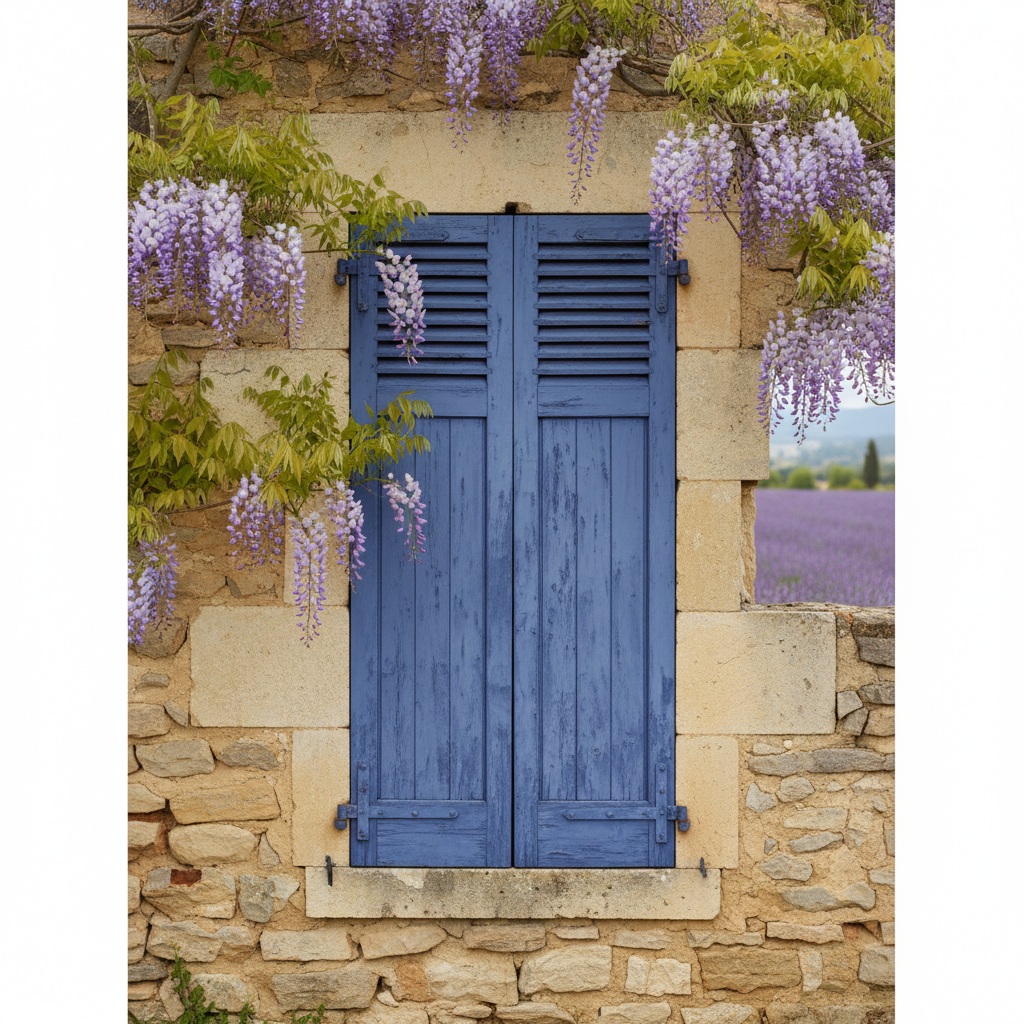
The architecture of Provence is an architecture of negotiation. It is a dialogue with a climate of extremes — the generous, often overwhelming, sun and the abrupt, insistent wind. In this conversation, the most eloquent speaker is the humble wooden shutter, or '''volet'''. To the passing observer, it is a charming feature, a constituent of the region’s deep aesthetic appeal. But to the resident, it is the most useful tool the house possesses.
Its primary function, of course, is the moderation of light. The southern sun, which coaxes lavender and grapes from the soil, can be a tyrant indoors. Long before air conditioning, the shutter was the primary means of creating a cool, livable interior. From mid-morning until the late afternoon, they are drawn shut across the region, plunging rooms into a dim, quiet peace. The light that enters does so indirectly, bouncing off stone floors and pale walls, stripped of its thermal force.
The iconic colours — a spectrum of blues, greens, and greys — are themselves a piece of this story. The traditional palette arose from the pigments available locally. The famous '''bleu provençal''' was one of the more expensive pigments, historically, while a muted grey-green was common. Under the relentless sun, these colours fade and bleach, recording the passage of seasons on their painted surfaces. Each shutter becomes a document of the weather.
Life in a Provençal village is lived in accordance with the rhythm of its shutters. The morning clamour of wood and iron as they are thrown open to the new day is a kind of communal alarm clock. The coordinated closing in the afternoon signals a collective retreat from the heat, a shared period of quiet known as the '''sieste'''. In this, the shutter is a social mediator, defining the boundary between the private home and the public life of the square.
An Instrument of Negotiation
The shutter does not just block the elements; it curates them.
Beyond the sun, the shutter is a shield against the Mistral. This wind, which sweeps down the Rhône valley, can be a violent, unnerving force. It is a dry, cold wind that can last for days, and the heavy, solid wood of the volets provides a necessary barrier against its force and ceaseless noise. They offer a sense of security, enclosing the home against the turbulent world outside.
There are two principal forms: the solid panel and the louvred '''persienne'''. While the solid shutter offers a total blockade, the persienne is a more subtle instrument. Its angled slats block the high, direct sun of midday while still permitting air to circulate. It is a remarkably sophisticated piece of passive cooling technology, allowing for ventilation without sacrificing shade or privacy. One can sit behind a closed persienne and feel the breeze, catching oblique glimpses of the world outside.
To appreciate the shutter is to appreciate a pre-industrial wisdom. It is an acknowledgment that the most effective way to live in a place is to work with its inherent conditions, not to brute-force them into submission with machinery. The shutter is a tool of adaptation, a quiet testament to centuries of learning how to live well in a specific place. It is a technology of nuance, not of power.
Collectively, the shutters create the visual texture of the region. A single shutter is a simple object. But a village of them, a facade patterned with their regular, rhythmic forms, is a powerful statement. They impose a sense of order and harmony on the built environment, their repeating shapes a kind of architectural refrain. Each is an individual choice, yet they contribute to a coherent, collective whole.
The sounds they make are as much a part of the place as their colours. The rattle of a latch, the soft thud of wood against a stone jamb — these are the ambient noises of domestic life. They mark the beginning and end of the public day, the transition from the communal to the private sphere.
Our complete study of the region’s material culture, including architectural plates and a directory of resources in Provence, France, is available in Edition IV of the journal.
The longer reading lives in the magazine.
This essay is one observation. Edition IV carries the plates, the studies and the directory of Provence, France — thirty pages, on uncoated stock, posted across Europe.
Continue reading
All essays → Editorial · 8 min
What a house is worth, and what it costs
On the difference between price and value, and why we have stopped using the first to describe the second.
 Markets · 11 min
The quiet market
Why the most interesting European homes are no longer listed, and what that means for the people looking for them.