The Slow Work of Becoming
In Tuscany, the ageing of Brunello wine offers a lesson in the deep, unhurried maturation of a home.
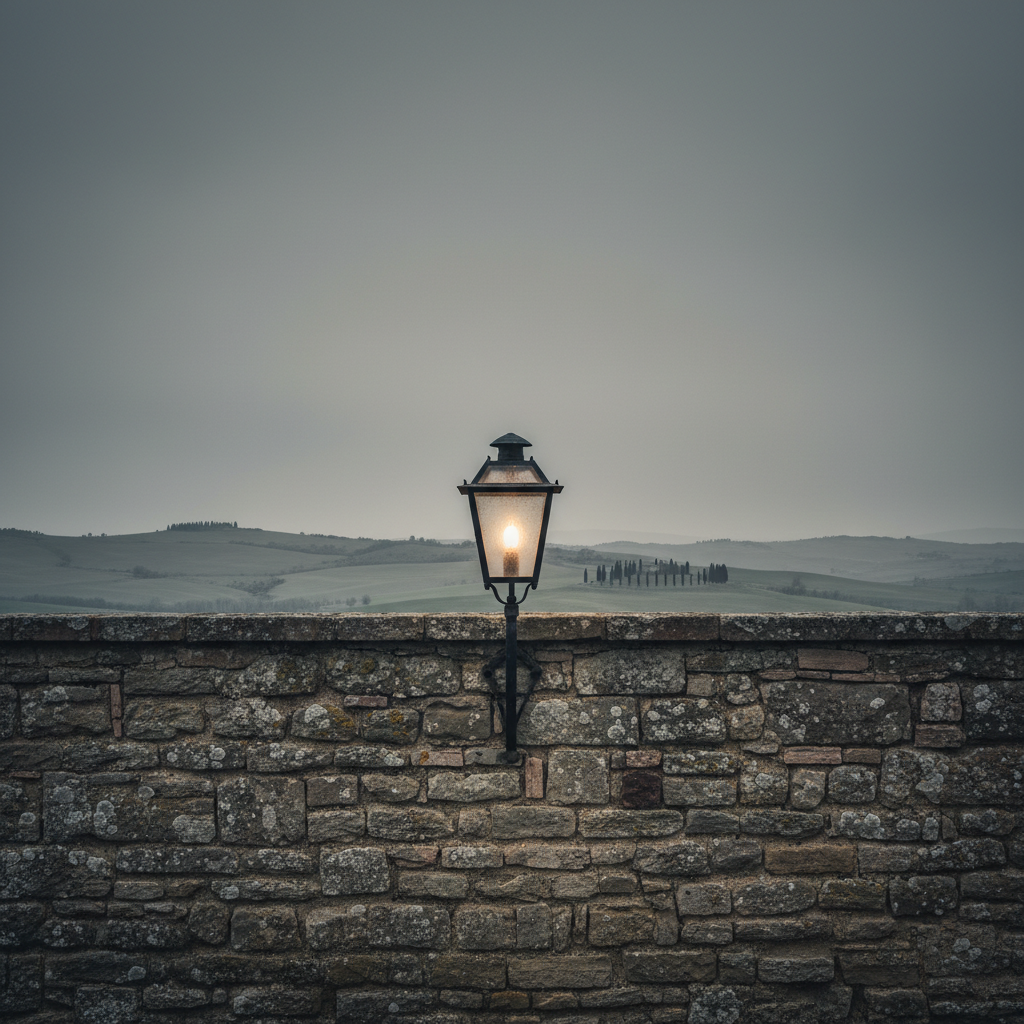
A bottle of Brunello di Montalcino does not reveal its character quickly. It is a study in patience, demanding years, sometimes decades, to soften its tannins and allow its complex notes of cherry, leather, and earth to emerge. The wine trade has a term for this: *evoluzione*. It is the slow unfolding of a thing into its truest self, a process of becoming that cannot be rushed. In Tuscany, one finds this same principle at work not only in the cellar, but in the very stones of its houses.
To build a home here is to engage in a similar act of patience. The materials themselves—travertine, terracotta, timber—are ancient, pulled from the earth with a sense of their own history. A new house in the Val d'Orcia is, in some sense, already old. Its stone walls have been shaped by millennia, and its timbers carry the memory of the forests from which they were cut. But like a young Brunello, a new house is still sharp at the edges. It is clean, precise, and not yet settled.
The first few years in a new home are a period of adjustment. The house breathes. Its stones expand and contract with the heat of the day and the cool of the night. The plaster develops hairline cracks, not from any structural failing, but as a natural expression of its settling into the landscape. These are the house’s first words, its initial attempts to communicate its presence. It is a dialogue that unfolds over seasons, a slow conversation between the structure and its environment.
One learns the particular qualities of the light as it moves through each room, marking the passage of the hours. The way a sunbeam strikes a terracotta floor in the late afternoon, the cool blue of the morning light in a north-facing study—these become the familiar rhythms of domestic life. The house begins to absorb the life within it, the faint scent of woodsmoke from the winter fire, the lingering aroma of coffee and baking.
The house, like the wine, is a vessel for time. It holds the memory of every season, every gathering, every quiet moment of solitude.
This process of inhabitation is a form of erosion, not of destruction, but of gentle shaping. The sharp corners of a stone step are worn smooth by the passage of feet. A wooden door handle takes on the patina of the hands that have turned it. A favourite armchair moulds itself to the body of its occupant. These are the marks of life, the evidence of a house being lived in, and they are as essential to its character as the architectural plans from which it was built.
The Patina of Place
Over decades, the house acquires a deeper history. The garden, once a bare patch of earth, grows into a tangle of rosemary, lavender, and climbing roses. The cypress trees planted along the drive, once slender saplings, become towering sentinels. Their roots work their way into the soil, binding the house more firmly to its place. The exterior stone, once pale and uniform, becomes a canvas of lichens and mosses, its colours shifting with the rain and the sun. This is the house’s *terroir*, the unique signature of its particular patch of earth.
A house that has been lived in for generations possesses a richness that cannot be replicated. It is a living archive, a repository of stories. The faint marks on a wall recall a child’s height, a worn patch on the floor marks the spot where a dog used to sleep. These imperfections are not flaws; they are the distillation of experience. They are what transform a structure of stone and wood into a place of belonging.
Like an aged Brunello, a mature house is a testament to the slow work of time. It has shed its initial rawness and settled into a state of quiet complexity. Its beauty lies not in its perfection, but in its accumulated layers of life, in the patina of inhabitation. It has become more than a shelter; it is a landscape in its own right, a place where the past and the present coexist.
This slow architecture, this patient settling of a house into its landscape, is the subject of our third edition.
The longer reading lives in the magazine.
This essay is one observation. Edition III carries the plates, the studies and the directory of Tuscany, Italy — thirty pages, on uncoated stock, posted across Europe.
Continue reading
All essays → Editorial · 8 min
What a house is worth, and what it costs
On the difference between price and value, and why we have stopped using the first to describe the second.
 Markets · 11 min
The quiet market
Why the most interesting European homes are no longer listed, and what that means for the people looking for them.