The Space Between House and Land
In the Alentejo, the terrace is not an afterthought, but a deliberate third room that mediates between inside and out.
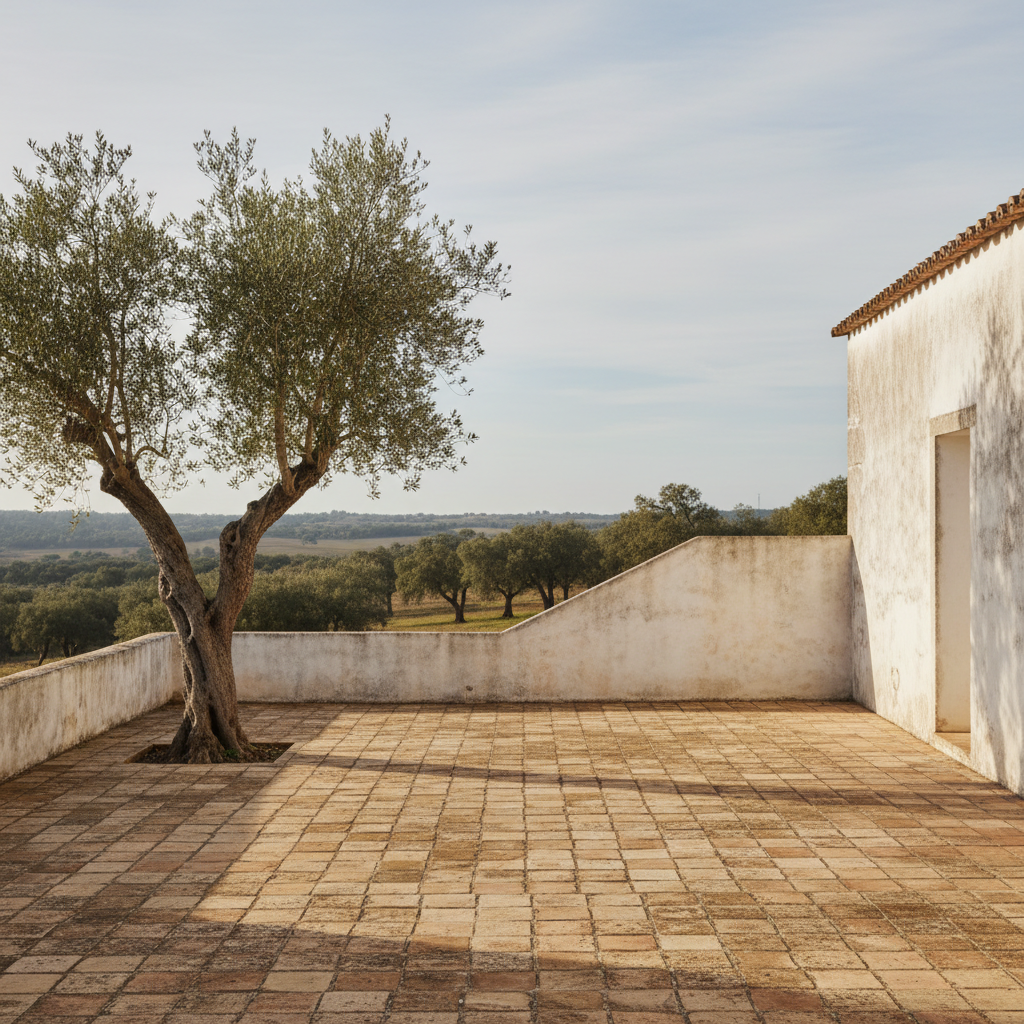
In the low hills of the Alentejo, the whitewashed farmhouse, or monte, asserts a quiet presence. It is a form born of function, shaped by the sun and the vastness of the surrounding cork forests and fields. These are not homes of grand gestures. They are built for shelter, for work, and for a deep, cyclical relationship with the land. Their beauty is an outcome of their utility.
Central to this utility is the terrace. Not a deck, nor a patio in the suburban sense, but a simple, elevated plane of terracotta tiles or packed earth. It is often little more than a wide step, a brick-paved apron that wraps a corner of the house, shaded by a single olive tree or a reed-covered pergola. It is the first and last point of contact with the home.
This is a space of transition. It is where dusty boots are kicked off, where baskets of olives are set down, and where the day’s heat is shed before stepping into the cool dimness of the house. It is a working space, a functional threshold that manages the boundary between the cultivated interior and the wilder exterior.
The terrace is a room with a roof of sky and a floor of earth.
It is a third room, one that is neither fully inside nor fully outside. It offers the stability of the home but demands an awareness of the elements. Here, one is sheltered from the direct sun but still feels its warmth. One is protected from the rain but still hears it on the tiles. It is a place of gentle exposure.
A Room Without Walls
Life on the terrace is life lived in observation. A morning coffee here is taken with the shifting light. An evening meal is accompanied by the sound of cicadas and the cooling of the earth. The space does not demand attention for itself; it directs attention outward, to the rhythm of the day and the slight changes in season.
This approach contrasts with the modern desire to erase the boundary between inside and out with seamless walls of glass. The Alentejo terrace does not erase the boundary; it makes it habitable. It acknowledges the difference between home and landscape, and creates a distinct, considered space in which to experience that dialogue.
The materials are of the place. The clay for the tiles is from the ground below. The lime on the walls is baked locally. The wood of the pergola is harvested from the forests nearby. This imbues the terrace with a sense of permanence and belonging. It is not an addition to the house, but an extension of the land itself.
Its design is an exercise in restraint. There is nothing superfluous. A chair, a small table, a pot of geraniums—these are often the only furnishings. The luxury of the terrace is not in its features but in its profound sense of place, offering just enough to make the connection between the dweller and the world feel intentional.
The longer reading on the Alentejo house, with plates and a directory of the region, lives in Edition I of the magazine.
The longer reading lives in the magazine.
This essay is one observation. Edition I carries the plates, the studies and the directory of Alentejo, Portugal — thirty pages, on uncoated stock, posted across Europe.
Continue reading
All essays → Editorial · 8 min
What a house is worth, and what it costs
On the difference between price and value, and why we have stopped using the first to describe the second.
 Markets · 11 min
The quiet market
Why the most interesting European homes are no longer listed, and what that means for the people looking for them.