The Stillness of a Tuscan Grove
The Japanese practice of shinrin-yoku, or forest bathing, finds a new but familiar language in the oak groves of Italy.
The term shinrin-yoku, or “forest bathing,” was developed in Japan during the 1980s. It describes the practice of immersing oneself in the atmosphere of the forest, a sensory experience distinct from hiking, trekking, or other goal-oriented excursions. The aim is not to conquer the trail but to absorb the environment, to engage the senses fully and without hurry.
It is a practice deeply rooted in the natural landscapes of Japan, from the hinoki cypress forests to the bamboo groves. But can an ethos so tied to a specific place be translated? To move the practice from one continent to another is to ask what, exactly, is being carried across.
The immediate image of Tuscany is one of rolling hills, silver-leafed olive trees, and sentinel cypresses against a wide, cerulean sky. Less depicted, but no less native to the region, are its dense oak forests. Here, in the foothills of the Apennines, the air carries a different weight, scented with damp earth, wild mint, and the faint, sweet decay of fallen leaves.
Walking in a Tuscan quercus grove is a wholly different sensory experience. The light is dappled, not filtered; the ground is a thick carpet of russet leaves that rustles with each step. The sounds are of the European woodland: the call of a cuckoo, the distant chime of a village bell. It is not an imitation of a Japanese practice, but the discovery of a parallel quietude.
The forest does not demand interpretation. It asks only for your presence, a quiet exchange of breath.
This experience of external quiet has a way of shaping our understanding of internal space. It suggests that the environments we build for ourselves might also serve as sanctuaries, not just shelters.
The Wellness House
The idea of a wellness house is the architectural extension of this principle. It is a structure designed to be a permeable membrane between its inhabitants and the natural world, rather than a fortress against it. Its purpose is to foster the same sense of calm and presence one might find in a quiet forest.
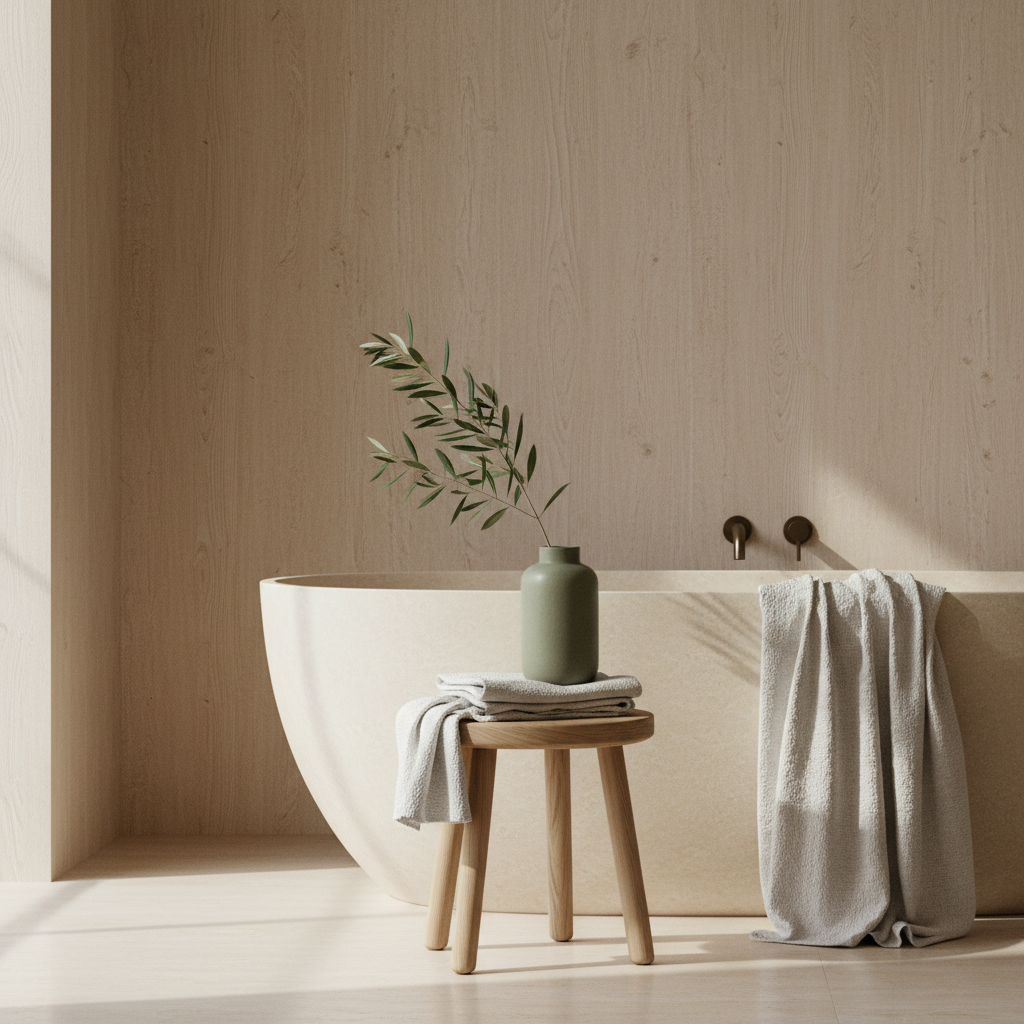
Such a home prioritizes natural light and unprocessed materials. Walls of pale oak and floors of cool travertine connect the interior to the landscape from which they were sourced. Large, unadorned windows frame the view not as a picture, but as an extension of the living space. A single olive branch in a vase becomes a quiet focal point.
This is not an imported aesthetic, but a modern expression of a deeply European tradition. For centuries, vernacular architecture across the continent has been defined by a direct and honest relationship with its local ecology. The wellness house is a return to this ethos, a considered response to the specific light, climate, and materials of its location.
Ultimately, the practice of forest bathing is about attentiveness. It is an antidote to the pace and distraction of the modern condition, a reminder of the value of stillness. It suggests that this deep, restorative connection is not exclusive to one location or another, but is available wherever nature can be met with quiet observation.
Further reading on the principles of the wellness house, with architectural plates from sites Across Europe, is available in Edition V of the journal.
The longer reading lives in the magazine.
This essay is one observation. Edition V carries the plates, the studies and the directory of Across Europe — thirty pages, on uncoated stock, posted across Europe.
Continue reading
All essays → Editorial · 8 min
What a house is worth, and what it costs
On the difference between price and value, and why we have stopped using the first to describe the second.
 Markets · 11 min
The quiet market
Why the most interesting European homes are no longer listed, and what that means for the people looking for them.