The Stillness of a Tuscan Oak Grove
The Japanese practice of shinrin-yoku finds new expression in the sunlit, ancient forests of the Italian countryside.
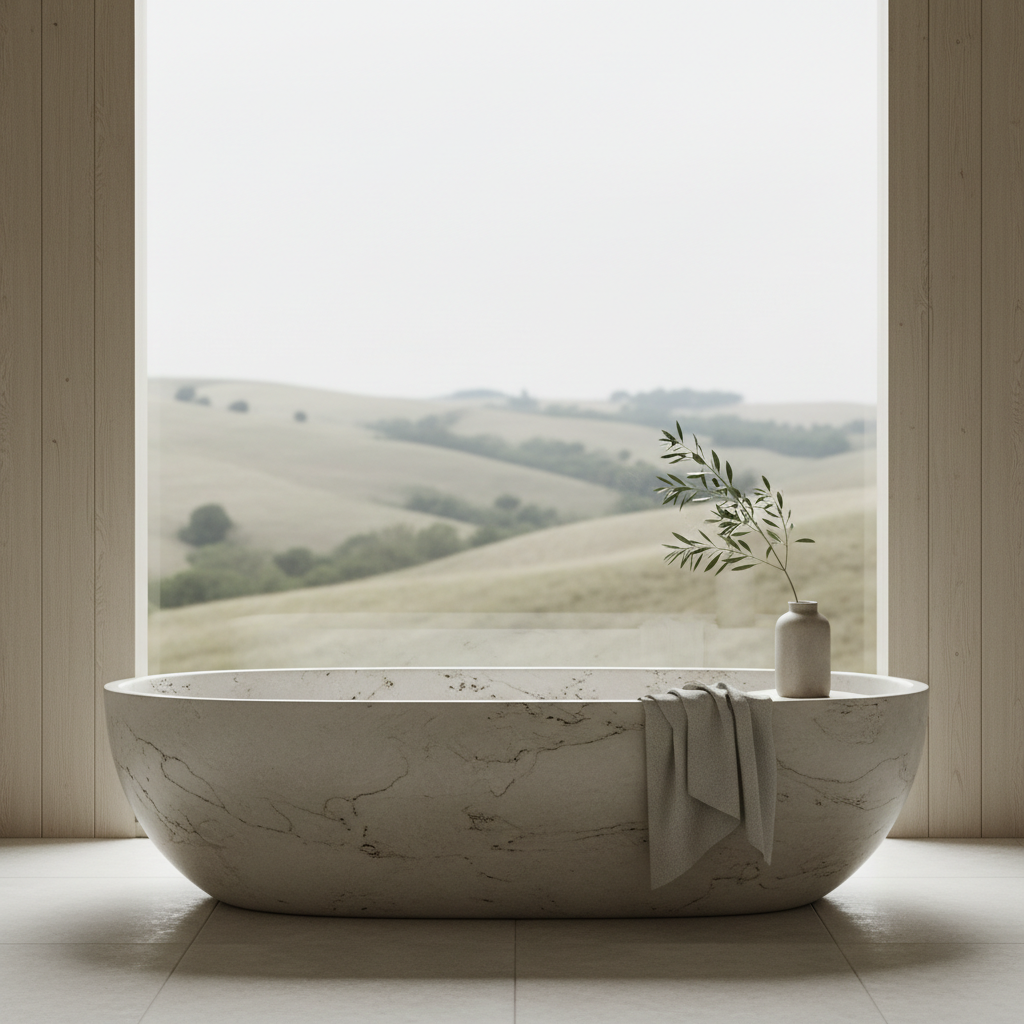
The term is Japanese. Shinrin-yoku, or “forest bathing,” emerged in the 1980s as a form of ecotherapy, a way to reconnect a person to the world outside the city. It is a practice of quiet immersion, of walking without destination among trees and allowing the senses to take in the atmosphere of the woods. In its native context, one pictures the humid, dense forests of Japan, a landscape of cedar, fir, and birch, often shrouded in mist.
But a practice, like a person, changes when it travels. To walk in the Tuscan countryside is to find a different expression of the same idea. Here, the forest is not a wall of green but a collection of clearings, a conversation between light and shadow. The oak groves that blanket the hills of the region have their own particular character, one shaped by a drier climate and a longer, more visible human history.
The air does not hang heavy. It carries the scent of dry earth, wild mint, and fennel. The sound is not of damp quiet but the electric hum of cicadas and the distant echo of a church bell. Where a Japanese forest might feel like a sanctuary of enclosure, a Tuscan grove feels like a point of prospect, a place from which to survey the surrounding valleys, the olive orchards, and the stone farmhouses that dot the landscape.
To walk in a Tuscan oak grove is to participate in a different kind of quiet.
This is not a lesser version of the original, but a translation. It suggests that the principles of shinrin-yoku are not bound to a single type of landscape but are instead a posture one can adopt anywhere. The goal is presence. The goal is to notice the world as it is, just outside the door.
A Clearing in the Woods
The wellness house, as a concept, often leans on a Japanese aesthetic of clean lines and natural materials. It is an architecture of calm. Yet, when placed in a European context, it too begins to adapt. The wood might be pale oak instead of cedar, the stone a local travertine rather than dark slate. The light it is designed to capture is the bright, clear sun of the Mediterranean.
The house becomes a threshold to the landscape around it. A window frames a view not as a picture to be passively observed, but as an invitation. The materials inside echo the materials outside, blurring the line between the built and the grown. A stone floor is cool underfoot, a memory of the earth beneath.
To step from such a house into the surrounding grove is a seamless transition. The practice of forest bathing begins before one has even left the room. It is a state of mind cultivated by an environment designed for stillness. It is the quality of light on a wall, the texture of a linen curtain, the simple form of a ceramic bowl.
In this setting, a walk in the woods is less an escape and more a continuation of an ongoing dialogue. It is an acknowledgment that the self is not separate from its surroundings, that the air inside is the same air outside, and that a sense of peace can be found in the simple act of paying attention to the world we inhabit.
The longer meditation on the European wellness house, with architectural plates and a directory of makers, is available in Edition V of our journal.
The longer reading lives in the magazine.
This essay is one observation. Edition V carries the plates, the studies and the directory of Across Europe — thirty pages, on uncoated stock, posted across Europe.
Continue reading
All essays → Editorial · 8 min
What a house is worth, and what it costs
On the difference between price and value, and why we have stopped using the first to describe the second.
 Markets · 11 min
The quiet market
Why the most interesting European homes are no longer listed, and what that means for the people looking for them.