The Stone in the Kitchen
The journey of a marble slab from an Alentejo workshop to a Lisbon counter is a story of place.
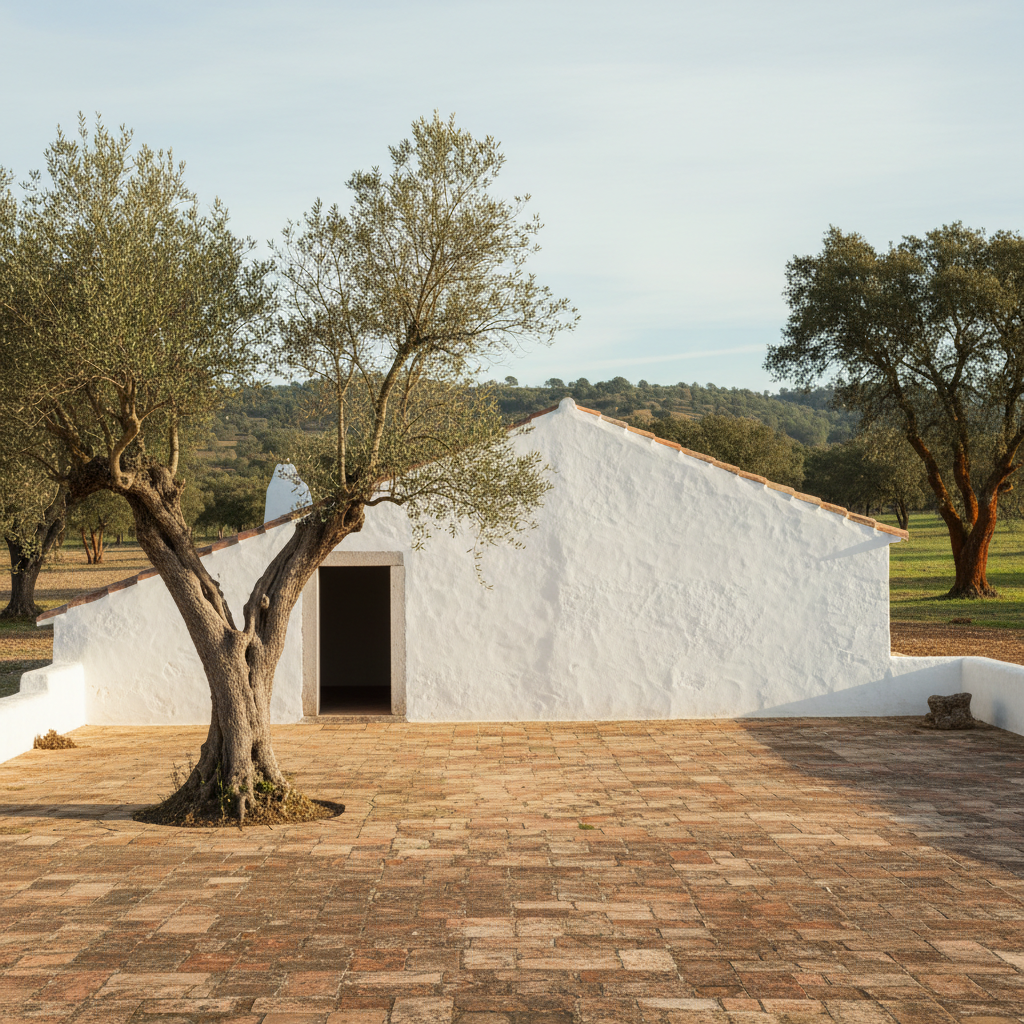
The kitchen is a study in white and wood, an unremarkable geometry of modern life. At its center, a plane of cool, pale stone anchors the room. It is a simple thing, a countertop, chosen for its utility and its quiet presence. Running a hand over its surface reveals a subtle geography of veins and fissures, a coolness that speaks of its immense geological age. It feels permanent.
In the considered design of a home, such surfaces are often the last thought, selected from a catalogue of materials engineered for consistency. Yet this slab is different. It does not feel engineered; it feels elemental. Its origin is not a factory, but a place. To understand the object is to trace its long journey from the earth.
That journey begins in the south of Portugal, in the Alentejo. The name means “beyond the Tagus,” the river that bisects the country. To cross it is to enter another state of being. The dense urbanity of Lisbon gives way to a vast and patient landscape, a region of sweeping plains, cork forests, and ancient olive groves.
Life here moves at a different pace, dictated by the sun and the seasons. The towns are clusters of whitewashed houses, their foundations seemingly growing from the soil. It is a land of artisans, of people who work with their hands, who understand the materials that the earth provides. This is the home of the stone.
The Estremoz anticline is one of the world’s great marble deposits, a vast reserve of stone that has been quarried since Roman times. To see the quarries is to witness a strange inverse architecture, a mountain turned inside out. Geometric voids are carved into the land, and from them, monumental blocks are lifted, raw and freighted with potential.
The slab is cut from the earth, but the counter is made in the workshop.
From the grand scale of the quarry, the block is transported to a small, dusty workshop, an *oficina*, often run by a single family for generations. Here, the noise of the city is replaced by the high whine of a diamond saw and the steady hiss of water used to cool the blade and suppress the dust. There is no assembly line, only a handful of craftsmen.
The Nature of the Stone
The work is a process of slow reduction. The immense block is sliced into manageable slabs, each one a unique cross-section of the whole. The craftsman reads the stone, noting its character, its lines of weakness and its moments of beauty. A decision is made. The slab is cut to the precise dimensions of the far-off kitchen, its edges are shaped, and its surface is polished, again and again, until it reveals a deep, lustrous finish.
This is not mechanical reproduction. It is a dialogue between man and material. The finished piece is imbued with the quiet attention of its maker. It carries the dust of the workshop and the memory of the sun that baked the plains of the Alentejo. It is a thing of substance, not just of form.
When the slab finally arrives in the Lisbon kitchen, it is transformed. It is no longer a raw piece of geology but a surface for living. Yet it remains a piece of the Alentejo, a quiet ambassador for a slower way of being. It brings the silence of the plains into the heart of the city. The simple countertop is a landscape in miniature.
The consideration of such materials, and the homes they come to define, forms a kind of practical philosophy. The longer reading, which includes studies of the region’s architecture and a directory of Alentejo makers, is found in Edition I of the journal.
The longer reading lives in the magazine.
This essay is one observation. Edition I carries the plates, the studies and the directory of Alentejo, Portugal — thirty pages, on uncoated stock, posted across Europe.
Continue reading
All essays → Editorial · 8 min
What a house is worth, and what it costs
On the difference between price and value, and why we have stopped using the first to describe the second.
 Markets · 11 min
The quiet market
Why the most interesting European homes are no longer listed, and what that means for the people looking for them.