The Tax on a Soft House
The material palette of the moment—limewash, plaster, and linen—promises a life of quiet ease, yet demands a labor all its own.
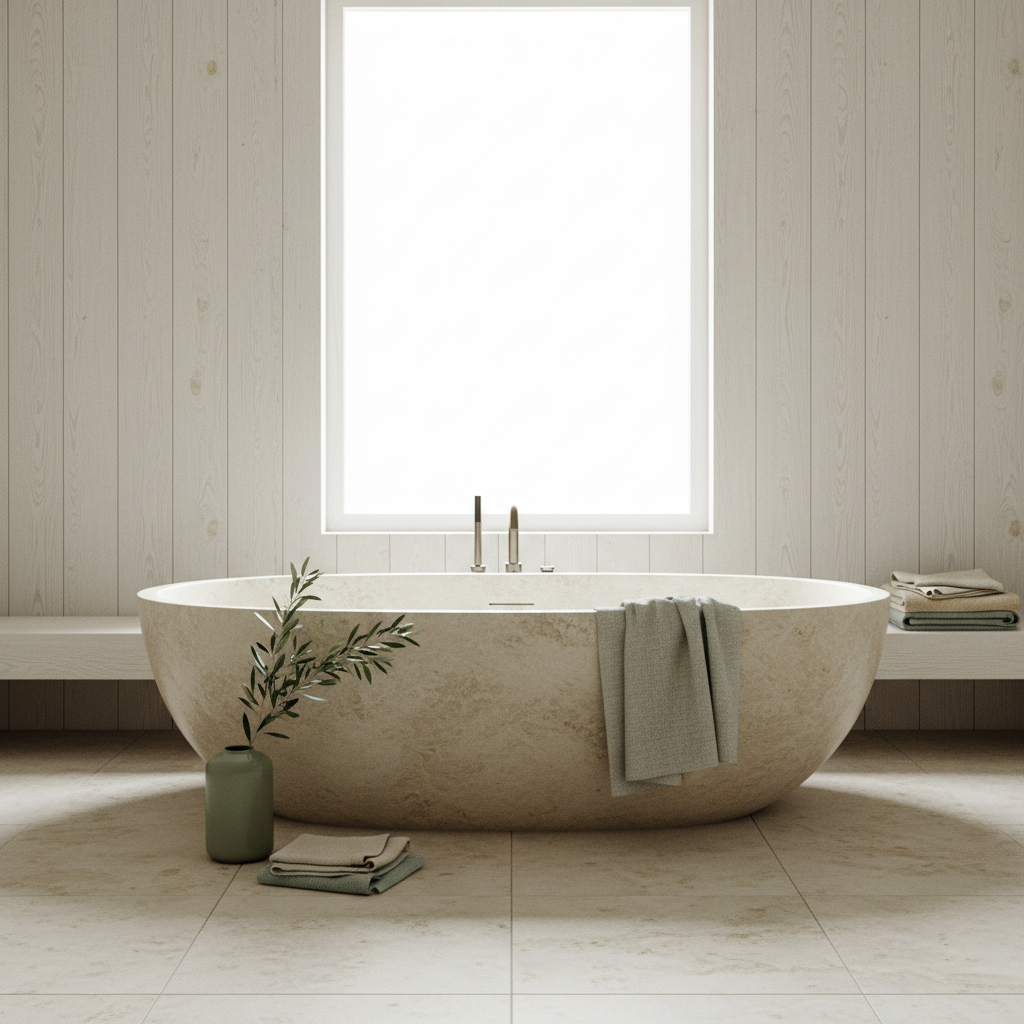
One finds a certain image repeated in the design journals of our time. It is a room of monastic simplicity, touched by a warm, glancing light. The walls are chalky, imperfect. The floors are pale, softened by a rug of undyed linen or wool. A single wooden stool, perhaps, or a deeply cushioned sofa upholstered in a textural boucle. It is a scene of immense calm.
This is the look of modern wellness, a visual shorthand for a life of considered quiet. It has roots in the sun-bleached vernacular of the Mediterranean, in the minimalist traditions of Japan, and in the raw, natural poetics of Belgian design. It speaks of a departure from the synthetic and the mass-produced, an embrace of materials that feel elemental and true. And it has become an aspirational standard for homes far beyond its origins.
To live in such a space, the image suggests, is to live gently. It is a retreat from the clamor of the outside world, a sanctuary built not of hard, reflective surfaces but of soft, absorbent ones. The materials invite touch. The light is managed for serenity. The sound is hushed. But there is a silent transaction involved in maintaining such softness, a tax that is rarely mentioned in the captions.
Consider the limewashed wall. It offers a depth and texture that conventional paint cannot replicate, its mineral pigments shifting with the day’s light. It is also porous and unforgiving. A scuff from a passing chair, a splash of coffee from a morning cup—these do not wipe away. They become part of the wall’s story, a gradual accumulation of marks that designers refer to romantically as patina. For the resident, it is often just a stain.
The soft house demands a harder life from its inhabitants, an unspoken agreement to tread lightly.
Unsealed plaster, porous stone, and natural fiber rugs present a similar challenge. They are chosen for their warmth and organic imperfection, for the way they ground a space in the natural world. But they absorb life’s accidents with an unnerving permanence. A spilled glass of red wine on a sisal rug is not a minor incident to be quickly remedied; it is a lasting event. The quietude of the space is thus protected by a quiet vigilance.
The Unseen Choreography
The aesthetic of ease requires a choreography of immense care. It is a performance of minimalism that is anything but minimal in its demands. The boucle sofa, so inviting in its nubby softness, is a magnet for lint and a challenge to clean. The wide-plank, soap-finished floors, so pleasing underfoot, show every footprint and require a specific, often laborious, maintenance routine.
This is the central paradox of the soft house. The visual language speaks of relaxation, of letting go, of a life unburdened by material pretense. The practical reality, however, is one of constant, careful stewardship. It is an aesthetic that is often at odds with the untidy realities of daily existence, particularly in homes with children, pets, or a penchant for entertaining.
None of this is to say that these materials should be avoided. Their beauty is real, as is the sense of peace they can engender. But the pursuit of this aesthetic should be an informed one. It requires an honest assessment of one’s own tolerance for imperfection and a willingness to accept the labor involved.
The dream of the effortless home is a powerful one, but it is often just that—a dream. The most serene interiors are not those that are empty or perfect, but those that are resilient. They accommodate the lives lived within them, bearing their marks not as flaws, but as a quiet record of time.
The longer reading on the considered house, with plates and a directory of Across Europe, lives in Edition V of the magazine.
The longer reading lives in the magazine.
This essay is one observation. Edition V carries the plates, the studies and the directory of Across Europe — thirty pages, on uncoated stock, posted across Europe.
Continue reading
All essays → Editorial · 8 min
What a house is worth, and what it costs
On the difference between price and value, and why we have stopped using the first to describe the second.
 Markets · 11 min
The quiet market
Why the most interesting European homes are no longer listed, and what that means for the people looking for them.