The Village Keeps Its Walls
Every spring in southern Spain, the pueblos blancos reenact a tradition of community, labour, and dazzling architectural hygiene.
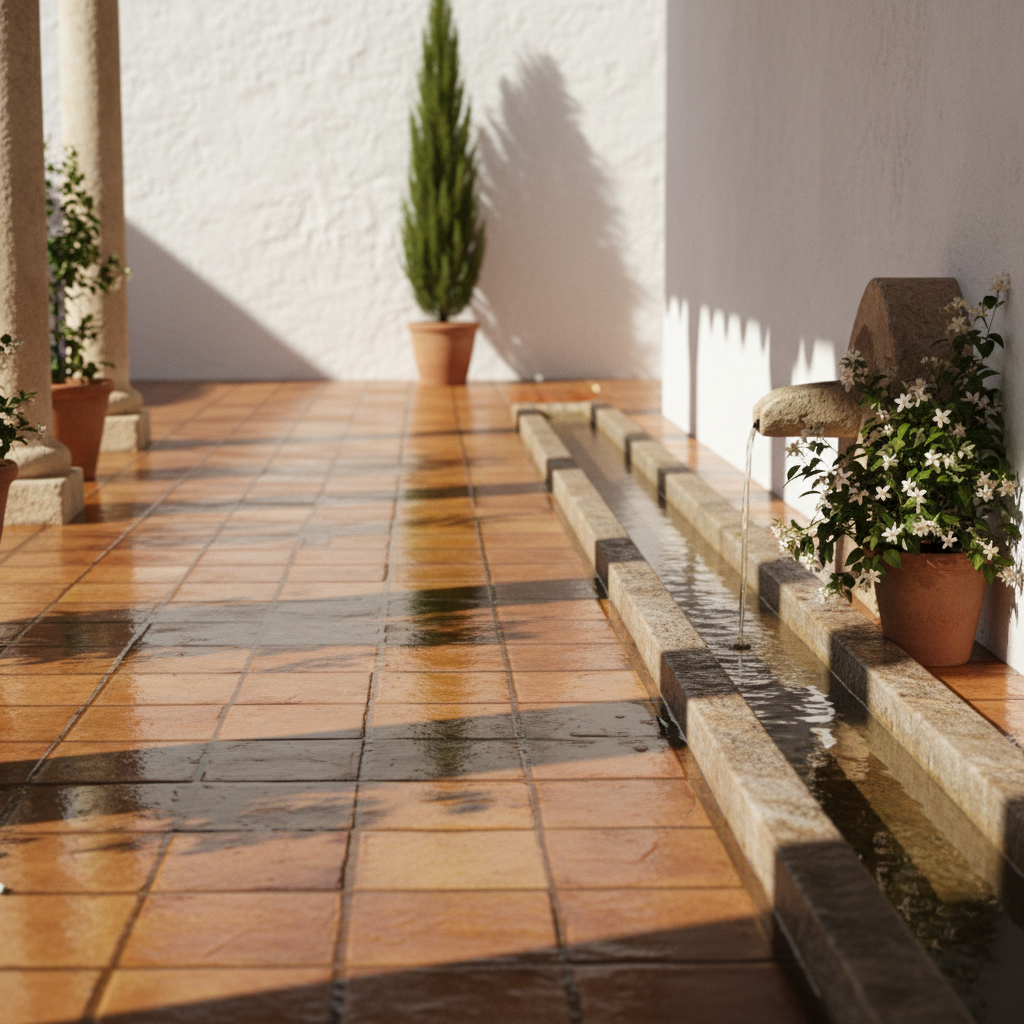
To arrive in the south of Spain is to be struck by the light. It is a pervasive, incandescent presence, capable of bleaching the colour from the sky and casting shadows of an almost solid blackness. The landscape surrenders to it. Yet the region’s villages do not. They hurl the light back at the sun.
The pueblos blancos, or white villages, of Andalusía are a defining feature of the landscape, their brilliant walls visible for miles against the dry, olive-stubbled hills. This is not the work of a single, historical act of painting, but an annual, collective undertaking. Every spring, as the season turns toward the unforgiving heat of summer, the villages are painted anew.
Entire communities—families, neighbours, friends—emerge with buckets of cal, or limewash, and wide, coarse brushes. They work their way through the labyrinthine streets, covering every surface. The stone underfoot is protected, just barely, by a scattering of newspapers or cardboard, but the walls receive the full attention, coat after coat, until they are impossibly, brilliantly white.
This is a ritual of maintenance, but it is also a quiet declaration. The fresh lime is a powerful disinfectant, a traditional and effective form of pest control that dates to a time when public health was a far more fragile enterprise. It is a cleansing, both literal and symbolic.
The Architecture of Care
The practicalities, however, only partially explain the tradition’s persistence. Limewash is not a modern, weather-proof paint. It is a simple, ancient mixture of slaked lime and water. It is breathable, allowing the thick, stone walls of the houses to release moisture. It is also impermanent. It chalks, it fades, it streaks. The winter rains wash it away in subtle-misted patterns, and the sun beats down upon it, returning it to a state of dusty imperfection.
To maintain the whiteness is to accept, even embrace, this cycle of decay and renewal. It is a discipline. It requires a village to choose, again and again, to protect itself not just from the sun, but from the slow slide into disrepair. The annual painting is a shared labour that reaffirms a collective identity.
A village is a living thing. Its walls are a membrane. To paint them is to care for them. To care for them is to care for each other.
One sees the work in the details: the crisp edge where a wall meets a heavily-varnished wooden door, the careful arcs cut around a window grille, the splash of white on an old terracotta roof tile where a brush has slipped. These are not the marks of industrial perfection, but of human hands. They are the collected evidence of a thousand small decisions, of a community looking after its own.
The practice speaks of a relationship with the elements that is not entirely adversarial. The sun is not an enemy to be defeated with chemicals and advanced polymers, but a constant, powerful companion whose effects must be managed. The walls are not sealed, but allowed to breathe. Life is not insulated from the seasons, but lived within them.
The gleaming surfaces also serve their most famous purpose: they reflect the heat. In a region where summer temperatures can settle above forty degrees Celsius for weeks on end, a white wall is not an aesthetic choice. It is a matter of survival, a simple and elegant piece of vernacular climate control. The entire village becomes a passive cooling system.
Our full reporting on the vernacular architecture and quiet industry of the region, complete with plates and a directory of Andalusía, Spain, can be found in Edition II of the magazine.
The longer reading lives in the magazine.
This essay is one observation. Edition II carries the plates, the studies and the directory of Andalusía, Spain — thirty pages, on uncoated stock, posted across Europe.
Continue reading
All essays → Editorial · 8 min
What a house is worth, and what it costs
On the difference between price and value, and why we have stopped using the first to describe the second.
 Markets · 11 min
The quiet market
Why the most interesting European homes are no longer listed, and what that means for the people looking for them.