The Walls That Breathe in Alentejo
In the sun-baked plains of Alentejo, vernacular architecture offers a quiet lesson in how to live with the land.
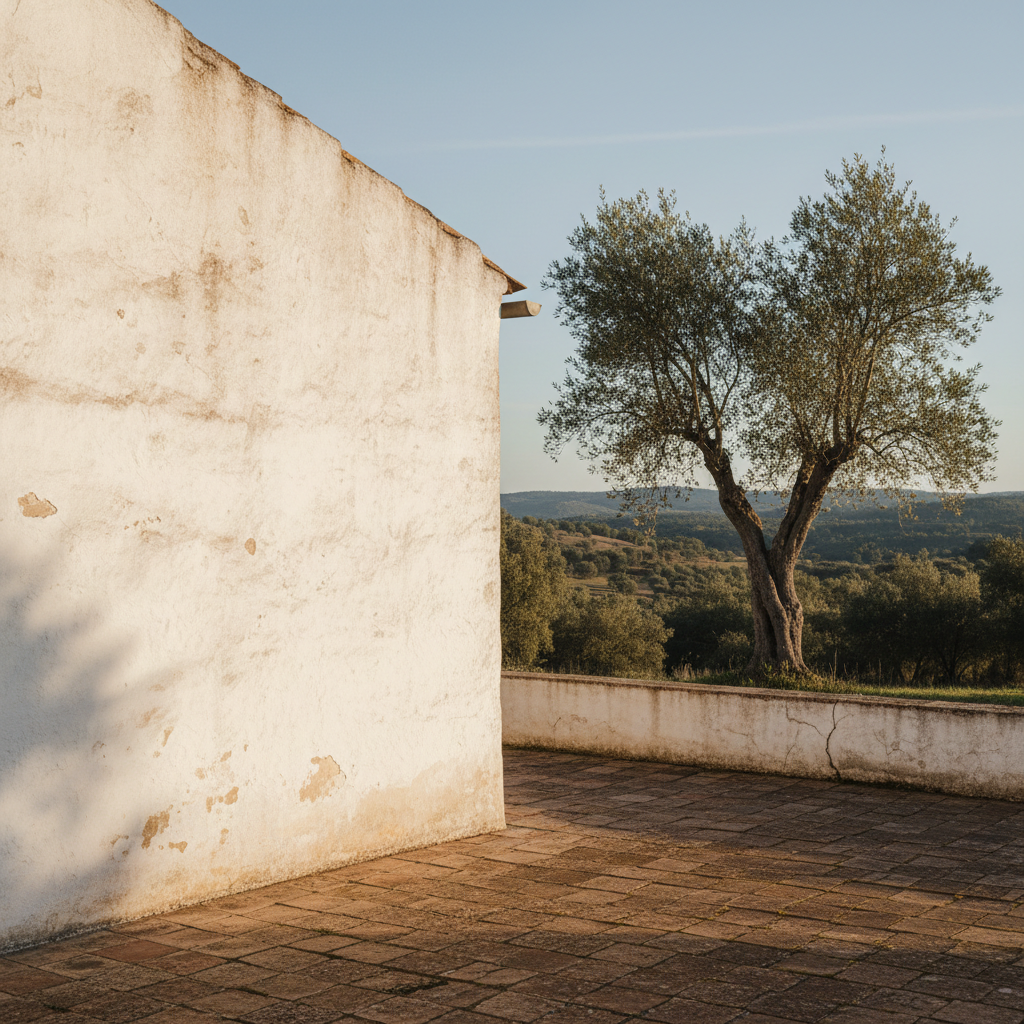
In the south of Portugal, stretched between the Algarve coast and the river Tejo, lies a landscape of rolling plains and quiet histories. This is the Alentejo. It is a region defined by its unhurried pace, its vast cork oak forests, and its profound, enduring summers. The architecture that emerges from this terrain is honest and spare, created not by architects in pursuit of a style, but by generations of people building with the materials at hand.
Most notable are the whitewashed walls of the farmsteads, or *montes*. They are simple, low-slung structures that appear almost as natural occurrences in the landscape. Their brilliance under the Iberian sun is not a modern aesthetic choice but a tradition born of necessity, observation, and a deep understanding of place. These are not static, sealed surfaces; they are dynamic membranes, coated in a lime wash that lives and breathes.
The practice is an ancient one. Lime, or *cal* in Portuguese, is produced by heating limestone and slaking it with water. The resulting lime putty is mixed with water to create a simple, luminous paint. When applied to the stone and earthen walls typical of the region, it forms a bond that is both beautiful and functional.
Modern, acrylic-based paints form an impermeable plastic film over a wall, trapping moisture inside. In a climate of damp winters and intensely hot, dry summers, this is a recipe for decay. Water that enters the wall cannot escape, leading to peeling paint, crumbling plaster, and a chilled dampness that clings to the interior air.
The Breathable Boundary
Lime wash works differently. It is vapour-permeable, meaning it allows the wall to breathe. Moisture absorbed by the masonry during the wet months is slowly released back into the air as the weather warms. The wall exists in a state of equilibrium with its environment, inhaling and exhaling with the turning of the seasons.
The process is both a science and a sensibility. It requires a tolerance for imperfection—a recognition that a house is not a static object but a living part of its surroundings. The lime-washed surface is not uniformly flat or sterile. It registers the passage of time, mellowing with age and developing a patina that speaks of the sun and rain it has endured.
A house is not a static object but a living part of its surroundings.
This porosity also contributes to a more comfortable interior. In the summer, as moisture evaporates from the lime-covered walls, it provides a natural cooling effect. In the winter, the dry walls offer better insulation than damp ones, creating a home that is healthier and requires less energy to heat. The high alkalinity of the lime also makes it a natural fungicide and insecticide, purifying the home in a quiet, unobtrusive way.
To coat a house in lime is to engage in a conversation with the seasons. It is an act of cyclical maintenance, often undertaken in the spring, that refreshes the home and prepares it for the year ahead. It connects the dweller to the substance of their shelter, a far remove from the detached consumption of modern building materials.
This tradition persists not only from thermal necessity but from a certain wisdom. It proposes that the most elegant solutions are often the simplest, and that a home should shelter its inhabitants not by fighting the elements, but by gracefully yielding to their rhythms.
The longer meditation on the simple home, complete with plates and a directory for Alentejo, Portugal, is available in Edition I of our journal.
The longer reading lives in the magazine.
This essay is one observation. Edition I carries the plates, the studies and the directory of Alentejo, Portugal — thirty pages, on uncoated stock, posted across Europe.
Continue reading
All essays → Editorial · 8 min
What a house is worth, and what it costs
On the difference between price and value, and why we have stopped using the first to describe the second.
 Markets · 11 min
The quiet market
Why the most interesting European homes are no longer listed, and what that means for the people looking for them.