The Walls That Breathe in Alentejo
In the sun-beaten heart of Portugal, traditional lime-washed walls are not merely an aesthetic choice, but a living technology.
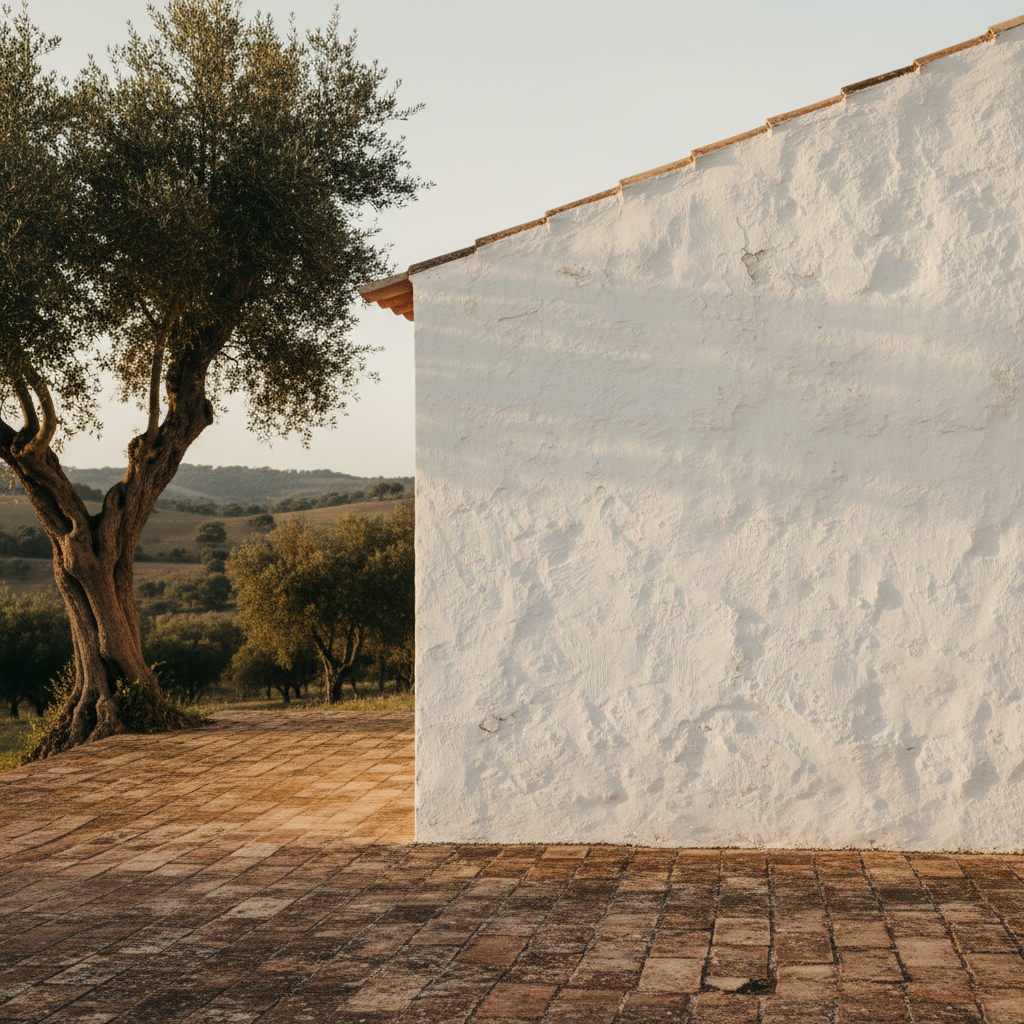
The archetypal image of southern Portugal is a landscape of rolling cork oaks and olive groves, punctuated by the stark, brilliant white of a farmhouse, or monte. These buildings appear elemental, as if they have always been there. Their brilliance against the deep green and ochre of the countryside is not a modern affectation but a tradition born of climate, material, and a deep understanding of place.
The whitewash, or caiação, is a central character in this architectural story. Each spring, families across the Alentejo region have traditionally repainted the exterior and interior of their homes with a simple mixture of lime and water. This annual ritual is more than cosmetic; it is a conversation with the seasons.
Modern paints create an impermeable seal, a plastic-like shield over a building’s surface. They are designed to repel the elements, but in doing so, they trap moisture within the walls. This can lead to dampness, decay, and a host of other problems that plague contemporary construction. The old way is different.
Lime wash, by contrast, is a profoundly breathable material. Created by slaking quicklime in water, the resulting calcium hydroxide is applied as a thin coating. As it dries, it absorbs carbon dioxide from the atmosphere and turns back into calcium carbonate, or limestone. The wall is once again stone.
The house becomes a quiet participant in the cycles of the year.
This process is key to its genius. The lime-washed surface is not a seal but a porous skin. During the damp, mild winters, the thick stone and rammed-earth walls of an Alentejo house absorb moisture from the air. The lime wash allows this moisture to pass through and evaporate, preventing it from becoming trapped and causing the chill that seeps from modern, sealed walls. The house exhales.
A Dialogue with Climate
In the long, arid summers, the process works in reverse. The walls release their stored moisture into the interior, creating a subtle, natural cooling effect. The brilliant white color, of course, reflects the intense sunlight, further mitigating the heat. The building does not fight the climate; it engages with it in a slow, cyclical dialogue.
There is a humility to this technology. It acknowledges that a home is not a fortress against nature but a shelter in partnership with it. The lime itself is a natural antiseptic, contributing to the health of the living space in ways we are only beginning to appreciate again.
The annual reapplication is not a chore born of inferiority, but a rite of renewal. It marks the passage of time, a cleaning and clearing in preparation for the year ahead. It connects the inhabitants to their home through the tangible act of care. To live in such a house is to understand that a building is not a static object, but a living entity that requires attention.
In this, the simple lime-washed walls of the Alentejo offer a quiet but profound critique of our contemporary desire for maintenance-free permanence. They suggest that true sustainability lies not in resisting the elements, but in yielding to them with intelligence and grace.
The longer reading, with plates and a directory of Alentejo, Portugal, lives in Edition I of the magazine.
The longer reading lives in the magazine.
This essay is one observation. Edition I carries the plates, the studies and the directory of Alentejo, Portugal — thirty pages, on uncoated stock, posted across Europe.
Continue reading
All essays → Editorial · 8 min
What a house is worth, and what it costs
On the difference between price and value, and why we have stopped using the first to describe the second.
 Markets · 11 min
The quiet market
Why the most interesting European homes are no longer listed, and what that means for the people looking for them.